Wednesday, August 27, 2014

Why "Black-on-Black" Crime is Irrelevant (To Mike Brown's death, and pretty much everything else) and Why Black Lives Matter

Anyone who has paid even the slightest bit of attention to the murder of Mike Brown and subsequent mass demonstrations for justice has undoubtedly heard by now, most Black murder victims were killed by a Black person. This is undisputedly true. You know what else is true? Most white murder victims were killed by white people (and yet during the OJ trial, I don't remember leaders of the white community speaking out against white-on-white crime; why is it they only care about dead white people when they can blame Black people, to paraphrase the entire Fox News network). You see crime, like nearly everything else in American society, is incredibly segregated. In general, Black people rob Black people, white people rob white people, etc.

Obviously the fact the Black people have killed Black people before has nothing at all to do with the murder of Mike Brown. As Jon Stewart so aptly notes, to bring it up means to not only ignore the fact that plenty of Black people do care about, and are doing plenty to combat. Black-on-Black crime (just because you don't bother to look for something doesn't mean it doesn't exist), it also means you can't see the difference between someone being murdered by a gang member and someone being murdered by a uniformed law enforcement officer who has sworn to protect the citizens of their town. Now, gangs and police forces actually share quite a few similarities in both organization and culture, but I think it's pretty uncontroversial to suggest that police should probably be held to a bit higher standard than gang members.

But arguing all the specific points of why shouting "Black-on-Black crime also exists!" every time a white supremacist murders a Black child is pointless; I have a hard time believing the people making that argument actually think it's a realistic rebuttal to such stark evidence of institutional racism. Instead it's just a classic derailing tactic designed to push the conversation to all those horrible things Black people have done, conveniently leaving behind the murder of an innocent Black child by someone who has yet to be arrested or even investigated for their blatant crime.

Ultimately bringing up Black-on-Black Crime™ simply reveals how profoundly racist the person mentioning it is. Not just for the reason explicated above (and much more eloquently by thousands of of other outlets), but because it's essential premise is "There's another dead Black kid. Who gives a shit who killed them? They're all violent criminals who are going to die young anyway." Because the only reason completely unrelated murders become relevant to the case of Mike Brown (or Eric Gardner, or Amadou Diallo, or Sean Bell, or Trayvon Martin, or the hundreds of others) is if you think Black lives have no value, so the specific cause of their death is a pointless concern.

If you doubt me, spend a few minutes researching the media's response to literally any non-Black murder victim. Simply put, you will never find an article wondering why white people don't spend more time worrying about white-on-white violence, why gay people don't spend more time worrying about gay-on-gay violence, while women don't spend more time worrying about women-on-women violence, etc. (Obviously Black people can be gay and/or women as well, but in the question of whether a murder victim deserves any sympathy, Blackness seems to trump all else).

Why don't we ever find these things? Well, it could potentially be many reasons. But if the aftermath of Mike Brown's murder (and so many others like it) has taught us anything, it's that these non-Black lives have value to us. It's that we as a nation assume Black people had it coming, whether for something they did at that moment or something they did years earlier. And the only reason to feel that way would be because you feel Black lives have no value. After all, there may be a reason why this has become one of the central rallying slogans in the wake of Brown's murder:


Monday, August 25, 2014

Say Nice Things To The People You Like

My high school vocal coach passed away this past weekend, far too young. It got me thinking, as such things tend to do, and I had the supremely trite realization I should be better about telling people what they mean to me. According to her obituary in the ol' hometown newspaper, she died in hospice, so I'm guessing she had some sort of serious terminal disease, though the fact that I have no idea what it was is probably a good indication of how frequently Julie and I have spoken over the past several years.

Losing touch with someone is not a particularly novel or malicious thing, as pretty much all human beings can attest. This specific case was not unlike most every other person I've lost touch with; I moved away to college and then grad school, she moved to the West coast for a job, I moved out to the East Coast, etc. and somewhere along the way we just quit contacting each other as we took smaller and smaller roles in each other's life.

But she was one of the most formative educators I've ever had. I started taking lessons from Julie when I was a freshman in high school and continued through most of college, and over time her house became not just the studio, but a second home, to me and countless other students of hers. She was the first teacher/mentor in my life (as I imagine she was for a lot of others) that treated me like an adult, and her life advice was just as good as her voice instruction. I could go on, but the simple point is that she was hugely influential in my life.

And of course I never told her this. I imagine she was probably plenty aware of how much she touched the lives of those around her, but at the same time, I doubt anyone would mind hearing in detail how profound a positive contribution they've made to the lives of others. But I never told her anything of the sort, and now she's passed away.

I've got nothing revelatory or insightful to add. There's a reason things become cliches, etc. But every once in awhile life reminds you that you should probably let the people you love know you love them. So go do that right now.

Thursday, August 21, 2014

It Begins...

I've made no secret of my love for The Simpsons on this blog and in real life, so it should surprise exactly no one that I'm insanely pumped for the start of FXX's "just hook it o my veins!" marathon. Starting 15 minutes ago, the far-flung cable channel will be playing every Simpsons episode ever, in order. In light of the horrible cep going on in our world in that past few weeks, it's a nice break. For once I can watch tv without being sent into a blinding rage (that is until they start getting to season 15 or so).

I thought about composing some sort of long-winded post about how much The Simpsons have meant to me over the years, but I'll save that for 2037 when the show is finally canceled. Instead I'll just muse on the fact that back in junior high my friends and I had this plan of taping every episode that aired so we could have a whole catalogue of the show. Little did we know at the time it would require roughly 8,000 or so VHS tapes, or that DVDs would make the entire enterprise pointless, or that someday a cable channel spun off of another cable channel would play the whole damn thing straight through.

Unfortunately, to remain gainfully employed, I cannot watch the entire run. I have, however, vowed to keep my tv on and tuned to FXX for the entirety of the run. That way, no matter what I'm doing or where I am in the house, the sweet sound of the Simpsons will be with me. What more could a fella want?

Just look at how much Captain Wacky has changed...

Thursday, August 14, 2014

Ferguson, The Commonality of the Police Riot, and the Long Road to Justice


This exists. We should all be incredibly ashamed.
If you're reading this, you've no doubt been following the horrific events unfolding in Ferguson. Touched off by the murder of an innocent child by an as-of-yet unnamed police officer, the town has become a virtual war zone (to the point where citizens of Gaza are tweeting the citizens of Ferguson helpful info on how to avoid tear gas and random beatings). There are so many horrible things Ferguson demonstrates about the current state of America, from the devaluing of Black lives (especially of young Black men), to the fealty of our major media (who ignored the tragic murder until social media forced the issue), to our depressing fondness for victim blaming (sure, an innocent child was murdered, but maybe he once did something bad?). I don't study those issues, so I'll leave all those points to others who can speak to them more eloquently (I highly recommend Greg Howard's piece America is Not For Black People). But I do study policing and actually have some expertise in that area, so this is what I can offer.

But before I begin anything, let me make one thing crystal clear: the death of Mike Brown is inarguably murder. Even if the current (albeit rapidly changing) story of the police (which just happens to contradict every eye witness) is perfectly true to what transpired, there is no legal justification for shooting an unarmed teenager who is several dozen feet away from oneself. The Tennessee v. Garner ruling clearly and unambiguously holds that the only time an officer of the law may use lethal force is in the immediate protection of life. That is, unless someone is directly presenting the ability to seriously harm another human being, police are not allowed to shoot to kill. By even the police's own account, Brown did not pose any immediate danger to anyone. This is not a justified use of force, this is not an accident, this is the illegal taking of a human life, which we colloquially and legally refer to as murder. But back to what I actually want to talk about...

My very first ever academic publication was on the subject of police riots, situations in which law enforcement officers are the principle (often only) perpetrators of violence and disorder. Developed by Rodney Stark in the late 60s, the concept still holds as the best way to understand what police in Ferguson are doing right now, as the extreme militarization of our police has only made such riots more common. In fact, Ferguson right now is almost the platonic ideal of a police riot.

Police riots typically follow six steps: some type of incident (say, the murder of an innocent child) leads to a convergence of people. The police do not like people looking at what they're doing, especially when they are committing blatant crimes (which would be why they are currently arresting journalists in Ferguson without even bothering to make up criminal charges), so this leads to some sort of confrontation. In the third step, police demand the dispersal of everyone, often demanding they return home.

This is the step when a riot is imminent; often crowds cannot disperse and go home because they are already home. This is happening on the streets in front of their houses. The people of Ferguson have no other "home" to go to. Or, as is very often the case, the orders are contradictory. Police are rarely trained in any meaningful way for these types of situations, and communication between law enforcement when order breaks down is spotty at best, often non-existent. So it's quite typical that people actually trying to do what the police tell them cannot; a famous incident from the limited police riot at the 2008 RNC in St. Paul illustrates this: police on one side of a long bridge told everyone they had to exit the other side of the bridge, while police on the opposite side said the mirror opposite, leaving no legal way to leave. So the crowd does not disperse and police begin to use force and arrested everyone on the bridge for failure to disperse (check out the not-that-greatly edited but containing awesome raw footage documentary "Terrorizing Dissent" which covers the incident). The point is that crowd had no way to legally disperse, so the use of force will not "help" them disperse, it will just inflict pain upon them for no reason.

It's also important to remember that the riot gear police wear in preparation for such situations (which in itself is incredibly provocative) typically obscures the officer's face and all identifying information. You probably can guess what happens when you give a bunch of people in a tense situation a lot of firepower and the knowledge no one will ever know who they are, virtually guaranteeing a lack of consequences for their actions.

This leads to a limited riot in which police use force indiscriminately and arrest without provocation or cause (witness the WashPo reporter who was arrested and taken to jail, then released not only without charges, but no paperwork of any kind). Multiple reports and videos show that the Ferguson police last night simply went throughout town gassing journalist and even tossing tear gas into people's back yards. At this point, we have reached full police riot.

I'll take a quick moment to address the inevitable "what about the looters?!?!?!?!?!?" argument people make as if that somehow absolves the scores of egregious police abuses. Even ignoring the fact that the looting was limited to a small number of people in a neighborhood nowhere near the demonstrations and lasted for all of a few minutes, pointing to that as any justification for the actions of the Ferguson PD has the merit of arguing "It all started when he hit me back!" And as this great piece in the Jacobin points out, if you are systematically denied your rights in every avenue of life to the point where police feel fine murdering your children and leaving their dead bodies in the middle of the street to serve as a general warning to the community, what choice is there beyond the riot?

For truly the most important thing to remember about police riots is that the only factor distinguishing them from every day police practices are the size and scope. Police are not ashamed of the use of violence against innocent citizens, they often enjoy it greatly:


This is a t-shirt produced by the Denver FOP after the repeated beatings of innocent citizens during the demonstrations against the DNC. Take whatever stance you will on the merit of the demonstrators, but they unequivocally have the constitutional right to gather, air their grievances, and, you know, not be savagely beaten for it. But this is exactly the point I'm trying to make about police violence: it is not an aberration of which police are ashamed, but the kind of thing they make "hilarious" fundraising t-shirts out of.

Finally, I imagine/hope people are wondering what we can do to stop this sort of thing. Like all forms of social change, there are no quick fixes. Obviously identifying and fully prosecuting the officer(s) responsible would be a tiny first step to some form of justice. Furthermore, identifying and prosecuting the many officers who have been involved in the obvious beginnings of a cover up would help, too.

But to prevent the murder of innocent citizens and the indiscriminate use of force by police that turns our cities into grotesque parodies of war zones (I once spent 3 solid months spending every afternoon at major, volatile demonstrations in Iraq during the war, and the police used more restraint. Let that sink in for a few minutes) requires some massive changes. It requires us to value the lives of citizens, to recognize the inherent humanity of people of color, to resist the urge to arm our police to the teeth as if they're trying to overthrow a nation, to not place our trust in an obviously corrupt institution which does incredible harm to the communities it is supposed to be protecting. It requires fundamentally reorganizing not only our police (and courts, and prisons), but reorganizing the very concepts we have of crime and especially what we think constitutes "justice."

And if you've got any idea how to make that happen, trust me, I am all ears...

R.I.P. Mike Brown.

Wednesday, July 30, 2014

Anybody Have $200 They Want To Lend Me?


If you're not currently watching Nathan For You, you need to remedy that situation post haste. It's one of those shows where the premise sounds terrible, but it's only because all of the comedy comes from the execution. The short version is the show is centered around Nathan Fielder, whom the show's intro assures us graduated from a top Canadian business school with really good grades. As such, Nathan For You is a show about him going to struggling small businesses and reinventing them a la all those reality shows with that exact premise. The hook is that Nathan's advice is uniformly terrible, typically involving incredibly outlandish schemes that result in no business. The humor comes from the time worn observation that people are significantly more willing to do what you tell them, even if it makes no sense, if you have a camera crew with you. Witness last night's genius episode in which a lawyer, ostensibly believing this is just all for the cameras, signs a waiver without reading it, only to be told a short time later he has just signed a legally-binding contract in which he assumes all legal responsibility for anything the show may do (the scene of an actual, accredited lawyer realizing what he's done and physically fighting to get the contract from Nathan is hilarious).

Actually, last night's episodes may have been one of the best half hours of television I've ever watched in my life, which is saying quite a bit given the inordinate amount of time I spend watching television. Last night's episode was the payoff to a bit that captivated the news cycle and internet for a day or two this past year: Dumb Starbucks. It turns out Dumb Starbucks was an idea to drum up business for a struggling local coffee shop by exploiting a loophole in parody law that allows one to use corporate logos as long as they're being made fun of (essentially...I presume the actual law is slightly more complicated than that).

I don't want to spoil too much of what happens, because you should seriously go watch the damn episode this very second. But one small part I will reveal is that Nathan is advised by the hapless lawyer that he has a much stronger claim to parody with Dumb Starbucks if he establishes himself as a parody artist (the logic being people would associate him with parody, thus making his claim of parody in court much more plausible. Kinda like how no one is going to assume Pharrell is the one ripping off Weird Al).

So amongst the many things he does to establish himself as a parody artist, Nathan rents out a space and has an art show of his parody art. Which mostly consists of terrible puns on corporate logos. And now those pieces are up for sale on ebay with the proceeds going to a non-profit that provides education for homeless youth.

Perhaps you're interested in a beautiful TGIFart sign?


Or perhaps a disturbing advertisement for 1906 Flags theme park?


But to me, the piece to win them all, and with the bidding at a mere $177.50 as of this writing, would be the cups and kippas combo of Jamba Jews:


There are very few things a fella actually needs, but I think I may have just found one of them...

Sunday, July 27, 2014

Quick Bit on Gaza

One of the most powerful moments I've ever witnessed regarding the Israeli/Palestinian hostilities was from a young Palestinian man at a panel discussion of some sort I had organized as an undergrad. While the conflict wasn't the central topic of the panel, eventually someone asked him about it. Unfortunately I can't do justice to his eloquent discussion of the situation, but the part that always stuck with me was when he was describing the founding of Israel as a necessity, given what had happened in the Holocaust, he argued the Jewish people needed a homeland where they could be assured some measure of safety. But the problem is (again, he phrased this much more eloquently), that the leaders of Israel are essentially undermining the entire justification for the existence of the state by turning around and enacting such massive, racist violence on a different oppressed peoples.

Obviously he wasn't drawing a one-to-one comparison between the actions of the Nazis and the actions of Israeli hawks (to do so would be absurd), but he was getting at how the latter uncomfortably apes some of the detestable practices of the former. I was reminded of that this morning while reading this short piece from Glenn Greenwald, in which he notes the recent incredibly offensive statement of Benjamin Netanyahu on how Palestinians only trot out the "telegenically dead" bears a striking resemblance to something said years earlier:

Benjamin Netanyahu, yesterday, on CNN, addressing worldwide sympathy for the civilian victims of Israeli violence in Gaza:
They want to pile up as many civilian dead as they can. They use telegenically dead Palestinians for their cause. They want the more dead, the better.

Joseph Goebbels, November 16, 1941, essay in Das Reich, addressing Germany sympathy for German Jews forced to wear yellow stars:
The Jews gradually are having to depend more and more on themselves, and have recently found a new trick. They knew the good-natured German Michael in us, always ready to shed sentimental tears for the injustice done to them. One suddenly has the impression that the Berlin Jewish population consists only of little babies whose childish helplessness might move us, or else fragile old ladies. The Jews send out the pitiable. They may confuse some harmless souls for a while, but not us. We know exactly what the situation is.
Again, as Greenwald points out, to say the two are the same is absurd, but to deny the uncomfortable way in which Netanyahu is pretty much saying the exact same thing as Goebbels means you're being willfully blind. And any time you're words match up with those of Goebbels, it does not reflect particularly well on whatever point you're trying to make...

Friday, July 25, 2014

Chivalry, Feminism, and Ray Rice Beating His Fiancee Unconscious

If you follow sports at all, you know that this week the NFL handed down the punishment for Ray Rice, who was caught on camera dragging his then-fiancee/now-wife's unconscious body out of an elevator after he had beaten her unconscious. The punishment was a suspension of two games. To put this is in perspective, Browns WR Josh Gordon is suspended the entire season for testing positive for marijuana use a second time. To put it really into perspective, the punishment for a first failed test for marijuana is 4 games. Or to put it into sickening perspective, the NFL believes that the recreational use of marijuana is at least twice as bad as beating your wife unconscious.

As a feminist I'm obviously pretty opposed to beating a woman into unconsciousness (though to be fair, as a bleeding-heart hippie I'm opposed to beating anyone into unconsciousness). But I'm also uncomfortable with a lot of the sports world reaction that views this as bad because the victim was a woman. Never hit a woman for any reason I've seen about a million times. If it was "never hit anyone for any reason," I'd be fine with it, but it's not. Instead, so many are denouncing one sexist act with a different (albeit more of an opposite side of the coin type of thing) sexist worldview, one in which women are tiny, delicate flowers unable to fend for themselves and must be protected by big, strong men.

As you can tell from my disdainful tone, I obviously don't buy that line of logic, albeit obviously agreeing with those folks that Rice never should have done this. But it's not because she's a woman, it's for two reasons -- 1) she was his intimate partner, and 2) there's an amazing difference in physical size between the two.

On the first point, while all violence is bad, intimate partner violence is especially pernicious for many reasons. Obviously there are the physical effects, but also the psychological effects of someone you believe to love you and have your best interests at heart treating you in such a manner. And of course, we know this was not an isolated incident. Sure, I don't know either of these people, but I do know about intimate partner violence, as one of my close colleagues is among the leading experts in North America on the subject. And what we've learned from the scientific study of intimate partner violence is that it does not come out of nowhere and is never a single, isolated incident. By the time it gets to the point where you think nothing of beating your partner unconscious, you've already hit them multiple times. So to put Rice's slap on the wrist into even more context, this was the punishment meted out to someone we have every reason to believe (and no reason not to believe) is a repeat abuser.

But the second point is really where I diverge from the "don't hit girls" (these folks almost always use the term "girls" instead of "women," which I think speaks volumes about how they view the situation). And not disagree in the incredibly disgraceful way ESPN commentators have in which they keep raising the issue that maybe she was asking for it. Because some troglodytes defending Rice have suggested that maybe she hit him first, apparently justifying him beating her unconscious. But look at any picture of the two and you'll notice something obvious: Rice, the professional football player, is a big, muscular dude (5'9", 195 lbs, to be exact). His wife, on the other hand, is normal human size. This is why it goes from simple assault to a much more pernicious problem; if his partner was someone who could actually kick his ass, like say Ronda Rousey, and she was punching him, then sure it makes sense for him to defend himself physically. But the sheer size difference between Rice and his partner is what makes it so horrible, the gender doesn't really matter. It would be just as shockingly horrible had Rice beaten a man (or anyone of any gender) that much smaller than him.

tl;dr: It's not horrible just because he hit a woman. It's horrible because he beat his partner who was much physically smaller than him. We can condemn his violence without having to imply (or explicitly state, as many have) that women are incapable of defending themselves and need to be protected by men at all times.

Wednesday, July 16, 2014

Derek Jeter is Smelly and Stupid

In a perfect world, I wouldn't hate Derek Jeter. No one would. But no one would particularly love him, either. He would be remembered as an above-average hitting and below-average fielding short stop who put together a nice career (and by saying his defense is below-average is putting it nicely: his fielding is easily outshone by Adam Everett. Who? Exactly). But as Will Leitch so excellently points out, he's not allowed to be just another ball player. Instead, somewhere along the line, Jeter became representative of everything that gives Bob Costas a tiny li'l boner, and sports writers have made him into an emblem of everything the sport is supposed to be. And of course, the fact that he plays in the nation's largest media market has everything to do with his veneration. As Drew Magary points out, it's not just that Jeter allows the old fossils who write about baseball to wax rhapsodic about a better time in the game (you know, the time when those uppity negroes weren't allowed in, when popping amphetamines was just part of business, and when being a violent, racist alcoholic made you into a legend), but he also allows New Yorkers to jerk themselves off to how wonderful and special New york city is.

So instead of being treated like the overall slightly-above-average player he is, he has been turned into a demigod. One so important that the entirety of last night's All Star game was dedicated to him. A man so above the game that the announcing crew in the booth had already awarded him the MVP in the first inning, and could barely contain their disgust when the award was actually given to a deserving player. A man so important that while Glenn Perkins was pitching a perfect 9th inning for the game-winning save while playing for his home-town team in his home-town stadium, the on-field performance is completely ignored so we can continue to discuss number 2. A man so God-like that the opposing pitcher had to apologize in-game for having the audacity to admit what everyone knew: that he threw the old man (who is hitting terribly this season) an easy pitch so he could get a hit in his last All Star game. But no, to admit he did what everyone was expecting him to do and what everyone clearly saw him do with their own eyes would be to diminish the achievements of THE CAPTAIN©.

And this is why the man is so hated by large swaths of America (and why one beautiful fan made all of Minnesota proud by chanting "Over-rated!" loud enough for the cameras to pick up before Jeet's first at-bat). Because anyone who knows anything about how baseball and especially the baseball media work, knows that had Jeter played for the Twins (or the Astros, or the Brewers, or the White Sox, or the Mariners, etc.) that he would never be venerated to this extent. Instead, he might actually be judged fairly, seen as a pretty good player who stuck around for a long time, thus allowing him to pile up gaudy career stats (though had he not played for such a stacked NY team that allowed him over a hundred more at-bats per season than the average player, he probably never would have put up such numbers).

But he isn't judged fairly. He's THE CAPTAIN. He's Number 2. He's the guy you're supposed RE2PECT (I believe it's pronounced "re-two-pect," but I could be wrong). So the rest of us, the ones who see the player instead of the mythical God, grow weary of the constant praise. Eventually the weariness turns to exhaustion, the exhaustion to frustration, and the frustration to hate. So to all you Jeter-fanatics, it's your fault we hate him.

Hilariously Perfect Update:
Multiple outlets have complained that during the All Star game there was no tribute to Tony Gwynn, an all-time great who passed away recently. Well, apparently there was no tribute because Major League Baseball "did not want to slight anyone by singling out one individual." In completely un-related news, Derek Jeter was mentioned a mere 100 times during that same broadcast.

Monday, July 07, 2014

The Criminology of Baseball

Something I always highlight in teaching criminal justice courses is the fact that our criminal justice system (cjs), best summed up by Bill Bragg, is "not a court of justice but a court of law."The point being not so much that our cjs is a place where the pigs don't ever give anyone a break, but instead the less politically-loaded truth that courts are not a place where all involved seek the truth of a situation so that justice may be most effectively delivered, but is actually a place where two parties fight within the narrow confines of our myriad laws to get the best result as they define it (e.g. longer sentence for prosecution, shorter for defense). The grand point being, as I often explain to my students, having the truth on one's side in a criminal case is nice, but it's far from the most important factor in deciding criminal cases. If given the choice between being empirically innocent and having a really good lawyer, chose the lawyer every single time.

Sports are a great venue for demonstrating this principle, as the rules systems of most major sports are clearly modeled upon (and generally follow the logic of) our criminal justice system. But unlike our criminal justice system, we typically have video of the incident in question, often from a multitude of angles. As such, we typically know what actually happened (unlike in criminal cases in the real world). And yet, much like in our actual cjs, what actually happened is less important than how the rules set up to govern the process say the claim must be resolved.

Take this play from last week's As/Blue Jays game. The link has both a description of the play, and more importantly, video of it, so I highly recommend you go look at that. For those too lazy, here's a quick summation (for those who don't follow sports, skip this paragraph): the situation was the As had the bases loaded when their batter hit the ball to the first baseman. The Blue Jays first baseman fields the ball and attempts to tag the runner moving to second. The ump signals that he has missed the tag, so he throws home for the force out. Importantly, the catcher doesn't bother tagging the runner coming home, because it's a force play, so no tag is necessary. He clearly had plenty of time to make a tag, as the runner was still several feet away, but again, it wasn't necessary since in the video you can clearly see the catcher watching the first base ump signal the tag was not made.

The As manager then appealed the call at first base, and video replay shows the tag was indeed made. This means the play at home was no longer a force out and the runner should have been tagged, meaning he is now safe at home and has scored a run. The fact that had the first base ump made the correct call in real time would have left the catcher with more than enough time to make the tag is meaningless according to the rules.

This play is a great example of how our courts and greater cjs work entirely -- what actually happened is less important than how well one is able to argue in the confines of the rules. Logic, even that which all parties agree with (no one alive would dispute the catcher would have easily made the tag had he known he was supposed to) doesn't matter at all. Because the rules, for better or worse, leave no room for simply making a logical judgement call. So even though everyone knows the play would have ended with the runner at home being tagged out had the runner going from first to second been ruled out on the field, this is inadmissible evidence under the current rules.

None of this is to say our current structure of criminal justice rules (or sports rules for that matter) is necessarily good or bad, just to make the empirical observation that what happens in our criminal justice system is not about what actually happened, it's all about what is able to be argued by experts (well, hopefully experts) within these byzantine systems of rules. The only difference is that in sports we can go to the video record and draw our own conclusions of what happened, while in the criminal justice system we typically just have to hope things turned out for the best...

Monday, June 30, 2014

"You Know What I Can't Open? Cupboards!"

If your as massochistic as I am, it means you read comments on the internet with some regularity (not on all sites, I mean come on. But even on generally good sites it's still often a soul-crushing experience). One of the more interesting trends I see in these comments is in the wake of some public figure making especially racist/sexist/homophobic/etc. comments and receiving some sort of minor punishment for it (like not being on t.v. for a week or two). There are always the inevitable "it's the PC fascists gone too far!!1!!1!" but an interesting albeit common sub-genre of those comments is the "they're only saying what we're all thinking!" idea. In these types of comments the theory goes that not only is disparaging someone for being racist/sexist/etc. not only something one does because they're all "PC" but they don't even believe these "PC" thoughts to begin with. No, they're actually super racist/sexist/etc. as well, they just feel the PC pressure to not say that aloud. But secretly they really agree with whatever offensive thing was said.

This line of logic has always fascinated me. To begin with, the narcissistic solipsism of it is hilarious/disturbing (depending on how serious the topic is) to an insane degree -- for the people making this argument, there is apparently no one alive who genuinely disagrees with them, only people who are and are not able to voice that agreement depending on how much they value this mysterious notion of "political correctness." Though it does at least help explain why these folks are always so insistent on claiming everything is due to this weird, amorphous construct of political correctness -- after all, if everyone actually agrees with you, there must be some reason why they insist on pretending they don't agree with. Because there isn't actually anyone alive who thinks race doesn't explain everything about a person (and especially whatever worth they may have) or that sexism is stupid, or that gay people are human beings, etc.

But a recent psychology study finds a major root of this odd line of logic -- conservatives score significantly higher on measures of "truly false consensus,"meaning they are significantly more likely than others to express a desire to be like everyone else, and more importantly, assume everyone else thinks just like they do (on the flip side, more liberal people score significantly higher on thinking they're different from everyone else and experience "truly false uniqueness,"meaning they assume others disagree with them more than is actually the case).

This has really helped me to understand a line of logic I always thought to be disingenuous -- that is, when people claim "they're just saying what everyone's thinking" I've long figured they were simply trying to claim the mantle of the more popular opinion to shut down debate or make dissenters feel out of place. But it turns out that for many of these folks, they're not being disingenuous; they legitimately believe that everyone agrees with them, no matter how much evidence they have to the contrary.

This is one of those studies that raises so many more interesting questions (do people have these false feelings of consensus or uniqueness, which then leads them to certain political beliefs, or does the deeper one go into certain political beliefs make them more likely to feel those things? Or is it a mutually reinforcing movement in one direction?), but it does help explain a lot of comments on the internet. And pretty much the entire Bush administration. So that's something...


Tuesday, June 24, 2014

The More Things Change...


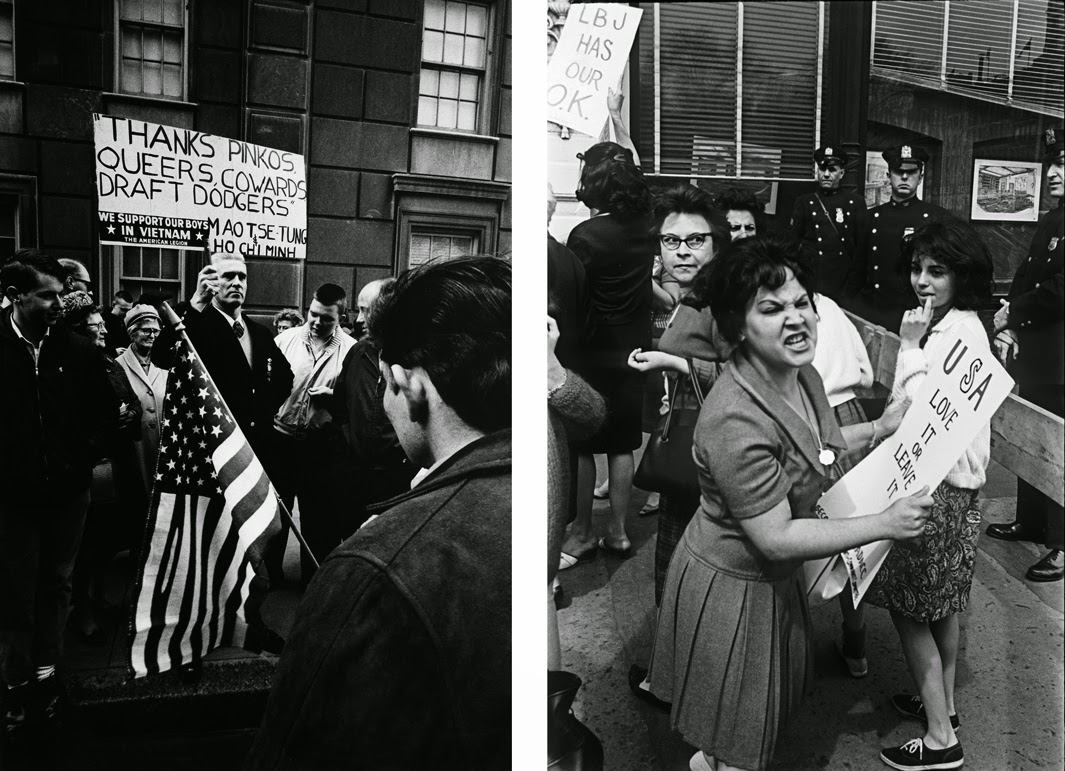
There's a great collection of 60s protest photos over at Slate, and they're definitely worth taking a few minutes to peruse. My particular favorite is a picture of some guys burning their draft cards who look more like they got lost on their way to the math club than they do crazy radicals. And that's one of the more powerful things that one is reminded of looking at the pictures -- as much as that decade and its political movements have been caricatured since then, it's important to remember these were real people, often  suffering real consequences for putting their reputations, bodies, and sometimes even lives on the line to fight for political change they believed in. And as much as they've been stereotyped as long-haired white burnouts and afro'd Black revolutionaries, most of the people in these various movements were just regular ol' people, indistinguishable from you, me and all the rest of upstanding society.

But what really strikes me about these photos is how very, very little has changed amongst those who oppose political progress. Check out the sweet sign the stoic citizen in the photo on the left has there -- virtually indistinguishable from the things I've had shouted at me at various demonstrations against my generation's pointless war of imperialism. I guess the weapons, tactics, and locations of our wars of folly can change, but our catastrophic failures will always be the fault of pinkos, queers, and cowards...

Thursday, June 05, 2014

Coded Language and Sports

To regular readers of this blog, it may appear as if I'm obsessed with racially-coded language. And to a certain extent I am. I think it's because dog whistle racism is one of those things that is so painfully obvious to anyone with a slight amount of awareness, and yet so many people continue to deny it exists. So I'm always interested when something like this comes along: deadspin recently posted a measure derived from hundreds of thousands of words in pre-draft scouting reports of potential NFL prospects and sorted them by race.

The results are not the least bit surprising to anyone who follows sports. In fact, I often assign watching an afternoon of football to my classes when I'm teaching about race: spend just a half hour watching football (or any sport with a decent amount of racial diversity) and catalogue the kinds of words announcers and commentators use to describe athletes of various races. Undoubtedly white athletes will get labels implying they work hard -- they're gritty, tough, blue-collar -- or that they are highly intelligent -- they've got game smarts, they're students of the game, etc. On the flip side, athletes of color are spoken of often as inhuman workhorses -- they're strong, powerful, natural, gifted athletes. The difference is that white athletes are spoken of as having worked hard and studied to get to their skill level, while athletes of color are spoken of as being naturally athletic (the implication being they're neither smart nor hard-working).

But lest I be open to claims of reading too much into this, let's see how scouts talked about white athletes:


And how did they speak about Black athletes? Well...


I could go on posting these all day, but I think you get the point. Seriously, though, you should just go try it out yourself. It's both an enlightening and depressing experience, as are most times one learns about the world...

Monday, May 26, 2014

So That Crazy Misogynist Murder Thing...

As you're already obviously aware, a highly-deluded Men's Rights Activist (redundant) killed several random women for not sleeping with him. I don't know of a better way to summarize it than with that seemingly incomprehensible sentence. I say that sentence is incomprehensible because it shouldn't be a sentence that exists and it should make no sense, but unfortunately it's exactly what happened. Even more unfortunate is the number of men who are earnestly arguing this is why women should sleep with any man who asks, walks by them, or just exists, apparently.

There's already been about a thousand different think pieces written on this, but this one is probably the best I've read. It's short and very well written, so I highly suggest you go take the three minutes necessary to read it. I'll wait. Done? Good. I really like how Dr. McDevitt highlights the impossible double standard young women (well, all women, but especially young women) in our society face: if you do have sex with men, you're a stupid whore who deserves to be bullied to death; if you don't have sex with men, you're a stupid controlling bitch who deserves to die for being withholding (if you're a woman who has sex with other women, you're allowed to film it for the pleasure of men, but you should be denied all civil rights, if I understand the argument correctly).

What I would like to selfishly add to the conversation is that this is why discourse matters, why fighting against misogyny in all its forms matters, and frankly, why sociology matters. Because analyzing the incredibly toxic form of masculinity subscribed to by these MRA types is exactly what sociology does, but it's also exactly the kind of thing that creationists* use to mock sociology as a useless discipline. "Why would you bother studying this and taking these people seriously? They're just some losers on the internet. Only people with nothing better to do with their time would think this is worth talking about." I've gotten that exact response from all sorts of people when discussing these kinds of issues, the idea that how people talk about things doesn't matter, and that if someone is espousing reprehensible  garbage we can simply ignore them and they'll go away.

But such a position fails to understand how important discourse is in creating real, material social effects. For a dramatic example, see John Hagan's work on how racial discourse was used to spur the genocide in Darfur. In this case, it's extremely clear how the toxic discourse and ideology of the men's rights movement strongly contributed to, if not caused, this horrible tragedy. As much as anyone may want to blame this on mental illness (whenever white people kill someone, it's always because of mental illness), it's simple empirical fact the vast, vast majority of people with mental illness never harm anyone (in fact, they are far more likely to be harmed themselves). Even if there is some magical psychological cause is found to be behind this, the particular form such murderous rage took was unequivocally influenced by this loose collective of men who feel women are unfairly controlling them and deserve retribution for their unforgivable crime of not fucking any man who wants them.

And that's why studying (and fighting against) these horrible forms of discourse is important and necessary. Because they're not just words, they're words that clearly direct people to action. And this particular murder spree is far from an isolated case -- in fact, that very same night, three men fired eight rounds at a fleeing group of women who had refused to have sex with them. I could go ahead and link to about a thousand similar stories, but it's too depressing and you have google. But please do remember this the next time someone claims a social issue is not important and we should just all ignore it.


*I've encountered far too many people, even highly educated people, that just dismiss the entire field of sociology out of hand, with essentially no knowledge of what sociology even is. They're using the same logic of creationists -- they either don't understand or don't like what sociologists have to say (or both), so they just claim it's not real. I've taken to referring to them as creationists, because most educated people rightly take that as an insult. But science deniers are science deniers, regardless of the specific science they're denying.

Thursday, May 22, 2014

What If We Treated All Education Like We Treat College?

By far one of the most annoying and disturbing trends in discussions around higher education is the pressure to conform a liberal arts education to the trade school model. That is, according to many, we should quit teaching all of this namby pamby "theory" and "art" and "literature" and anything else that isn't immediately and directly transferrable to one's future employment (leaving aside, of course, the fact that many things which don't seem immediately applicable to the job market, like say a better understanding of how various cultures interact, actually can significantly aid one in finding employment. Or the fact that we can't chemical engineer or business administration away institutional racism and structural inequality, but anyway).

I was especially reminded of this when mindlessly scrolling through this typically obnoxious buzzfeed post of commencement speech quotes that someone posted on facebook. The most striking was a quote from Ed Helms, saying "if you majored in Classics, that one's on you. We'll be seeing you and your bust of Euripides at job fairs for years to come." Even going beyond how dripping with unearned condescension that quote is, the fact that it's coming from an actor is especially rich. Especially one with a degree in film theory. You know, the exact kind of major someone at his own commencement probably made fun of for being useless and never leading to employment. Except of course it's led him to roughly $20 million net worth, indicating maybe it was a fairly worthwhile major after all, if you're measuring in terms of future earnings.

But my point is not about whether more esoteric majors can lead to good future earnings, and in fact, I think that is a profoundly misguided way to look at college majors. Because not everything learned in college needs to be exclusively and directly applicable to some sort of job. Beyond the obvious fact that the job market keeps evolving and there's a decent chance today's graduate may end up in a few years applying for a job that doesn't exist right now, a liberal arts education is not meant to be a vocational school. It's meant to teach you applicable skills, sure, but it's also meant to teach you how to be a well-rounded person with knowledge about the world.

I write this as someone who majored in Sociology and Humanities with minors in Music, History, and Philosophy. Every last one of them a "worthless" major according to the college-as-trade-school crowd. Yet here I am, gainfully employed in my chosen field. But the bigger point is that I didn't take those classes to get a job, I took those classes to learn things. Sure, my philosophy courses provided me with few skills applicable to the various jobs I've had, but they challenged my worldview and understanding of life in profound ways. Ways that made me a significantly better person for having pondered and worked through.

So I often wonder what elementary education would look like if we applied this same mentality. Learning to tie your shoes? No one's going to pay you for that. Learning right from left? No one's going to pay you for that. Learning addition and subtraction? No one's going to pay you for that. In fact, there's no job that's going to pay you for what you learn in grade school, so we should probably get rid of the whole thing, right?

Friday, May 09, 2014

Obamacare and Fun With Latin Logic Phrases

One of my favorite time wasting activities is looking up Latin phrases for logical fallacies (I clearly have a very active social life). It's not just that whipping out a Latin phrase at the right time makes you look super smart and/or pretentious, but that often they have a beautiful simplicity that captures a rather lengthy argument in just a few words.

But since I never studied Latin, I often find myself looking for a specific phrase but having to reverse engineer it through the magic of google (so I often find myself searching something to the effect of "Latin phrase meaning your conclusion does not follow your premises," or some such). Today's Latin logic phrase of the day is Ignoratio Elenchi, meaning when one presents an argument that is solidly logical, but does nothing to support the conclusion they're advocating.

I thought of this while reading yet another complain about the Affordable Care Act this morning and wondering why I find myself so often in disagreement with conservative critics of the ACA when I myself hate the ACA. I think it's because while there are many, many valid criticisms of the act, so many of the most vocal critics of it use what are basically non sequiturs in their attacks, clearly starting from the position that Anything Obama Does = Bad, and then working backwards from there to figure out why any particular action itself is bad.

For instance, one of the most common criticisms of the ACA I see from very vocal opponents is the idea that it will not be financially solvent unless enough healthy young people who rarely use their benefits sign up for it to defray the costs of taking care of older and/or sicker people who use many more resources.

The problem with this line of reasoning is that the idea that a health insurance program will only work with enough healthy people to offset the people actually using their benefits is not a criticism of the ACA, it's a criticism of the concept of health insurance itself. This is the exact logic the entire private insurance system is based on, a logic that was in place long before Mitt Romney and co. developed the plan that would eventually become the ACA. Now, if you were proposing an alternative in which our health care is socialized and the government uses the awesome purchasing power of 300+ million people to negotiate affordable rates on medical care, then you could criticize this model. But if your alternative is to return to the system that invented this model in the first place, the critique rings pretty hollow.

Which is what I think makes it such a good example of in ignoratio elenchi. Because the idea that young, healthy people who use very few medical resources are necessary to offset the costs of people who actually use medical resources is a valid critique of a system of medicine. But when your counterproposal to what exists is based on the exact same logic, well…again, that's just not a very good criticism. Instead, it's clearly a criticism that began with the assumption the ACA is terrible and then worked backward to find specific faults. Of which there are many, but this one doesn't work.


Thursday, May 08, 2014

Donald Sterling, "The Free Market" as Coded Language, and a McDonald's That Sells Spaghetti and Blankets

I've been following the whole Donald Sterling fiasco pretty closely and one of the most interesting arguments I've come across in the many pieces I've read about it is from a faction of people who believe the NBA should not have done anything and should have instead let the "free market" sort it out. Of course here I'm using the term "interesting" in the passive-aggressive Midwestern sense, in that anything that doesn't make sense gets politely termed interesting. Because this argument most definitely does not make sense.

What is this free market argument? As always, it involves the free market magically doing the right thing, but more specifically, these folks are arguing that the NBA was wrong to intervene, because had they just left everything alone, fans would have decided not to patronize the Clippers, players would have decided not to play for the Clippers, advertisers and other corporate sponsors would have cut ties with the Clippers, and on and on until the market forced Sterling out.

While this line of thinking obviously ignores quite a bit of what we know about reality (ranging from the fact that many fans have continued to support their teams through far worse controversies, players are under contract and can't just up and leave the franchise without huge difficulties, advertisers have shown their complete willingness to work with utterly despicable people, etc.), it's interesting in how it not only shows how humorous free market fetishism is, but how it's becoming a loaded code word on the level of "states rights."

Much as proponents of states rights will say that slavery or segregation were really bad and they truly, honestly disagree with the practice but just think the federal government doesn't have the right to intervene in such situations, the "free market will fix it crowd" similarly pretends to be upset with Sterling, but just doesn't like the heavy-handed actions of the NBA.

But I say "pretends to" because that's obviously not the case. Because the NBA has neither acted with a heavy hand according to their own corporate franchising model, but even more so because this is actually a pretty prime example of the market forcing this change (without any government intervention whatsoever).

Why isn't it heavy handed for the NBA to force a sale of the Clippers (which has not happened yet but appears quite likely at this time)? Because the Clippers are not an independent business, but a franchise of the NBA. This is why the NBA can have things like salary caps or the ability to trade their employees, because technically the teams are all just subsets of one corporate entity (the NBA). These things would be gross violations of labor and business law if all 30 teams were actually completely separate businesses. So it's more akin to how individual McDonalds are independently owned and operated, but at the discretion of the McDonalds corporation and the ability to run one can be revoked at any time.

Which brings mean to the McDs that only sells spaghetti and blankets, as imagined by the late, great Mitch Hedberg (the joke starts at about 44 seconds in):


For those to lazy to watch or for when the video is inevitably taken down, the crux of the joke is that Mitch notes the end of McDonalds commercials always end with "prices and participation may vary," so he jokes about opening a McDonalds that doesn't participate in anything. It's a good joke. But of course in reality if any McDonalds owner were to do anything even close to that their franchise would be yanked away immediately. Which is more-or-less what the NBA is doing to Stern Sterling (whoops! confused my S-named morons associated with the NBA).

But what really exposes the "Oh, I totally oppose what Stern Sterling has said and done, I just believe in the purity of the free market" argument to be a lie is that the free market is exactly why Stern Sterling is losing the team. The NBA, a private corporation, seeing the mountains of bad press, the threats of fans and advertisers to quit supporting the league until something was done, and a potential strike of both the Clippers and their first-round playoff opponent Warriors, decided that to protect their revenue streams, they needed to discontinue their relationship with Donald Sterling. This was all done without even the threat of government interference. A purely business decision made by a private business. The ouster of Donald Sterling couldn't get more free market if Ayn Rand came back from the dead to team up with Ron Paul to personally arrange a hostile takeover of the Clippers.

And this is why the free market argument is clearly a code word meant to derail the conversation from one about the continuing presence of racism in our society to one of how private businesses should be allowed to act. Because again, this was pretty much the model example of the free market taking care of things with no outside intervention. So if you're going to use the notion that it should have been left up to the free market when that is unequivocally what has already happened, it makes it pretty clear that maybe your problem is more that this was one of those rare occasions in which someone's life-long legacy of overt and institutional racism finally brought some consequences...

Tuesday, May 06, 2014

Privileged White Guy Does Not Believe In White Privilege

A you've probably heard or read by now, a Princeton freshman wrote an article for an astroturf conservative collegiate newspaper about how he's never experienced white privilege (despite, you know, being a freshman in college whose poorly written essay has now been featured in Time magazine, among many other outlets). I'm not going to link to it directly because the last thing dude needs is more page views, but here's a great take down of how moronic it is.

The reason the piece has blown up is pretty obvious, as it taps into a ton of white resentment over the fact that it's no longer particularly acceptable to publicly proclaim people of color stupid/unworthy and how that's apparently super unfair to white people.

I'm not here to explain what white privilege is or to prove it exists (I've written about it tons and tons and tons and tons before, and at this point in the development of the term and empirical findings in the field, if you're denying it exists you're basically the social science version of a creationist).

What's most annoying about this kid's tone deaf essay is the deliberate misunderstanding of the term. Literally no one is asking him (or any other white person) to apologize for being white or for getting where they are. The entire point of asking people to check their privilege is to simply remind them that the world is not particularly fair, and to remember that the unfairness of the world tends to work in their advantage. No one's saying you haven't overcome difficulties in your life, just that other people also have difficulties, and probably more than you do if you're a straight white guy at Princeton. Which, to borrow a popular analogy, is pretty much the lowest difficulty setting possible.

But this kid wrestling with the concept of privilege actually reminded me of a bizarro version of myself at his age. As a college activist only beginning to learn of the many horrors of our world I, like many others, began to feel like I was not allowed to be sad or upset about anything. Sure, that girl dumped me and broke my heart, but do you have any idea what's going on in Darfur right now?!?

It's a long process for many activists to realize that just because other people have it objectively worse than you doesn't mean you're not allowed to feel shitty when shitty things happen to you. A much healthier way to approach it is just to remember some perspective when you're feeling shitty. So I hit on a new way to think of the concept of checking one's privilege.

When I was a senior in college, I broke my ankle in a pick up basketball game. Not in the figurative sense that someone juked me out of my sneakers, but in the literal sense that I displaced a number of the "floating" bones in my ankle. And that really, really hurt. Like, "scream a string of obscenities every time I even tried to move my ankle for months" kind of pain. It took months of physical therapy to regain the use of that ankle, and to this day I only have about 75% motion in it.

Contrast this with a friend of a friend who a few years ago died from a very aggressive cancer. In fact, by the end, it had so thoroughly spread throughout his skeleton that his bones were literally snapping  due to the pressure of the enormous cancerous growths inside of them. His last weeks were spent writhing in unimaginable pain.

No obviously that guy's situation was simply objectively worse than mine, no matter how you slice it. Although breaking my ankle like that was by far the most physical pain I've ever experienced, it's not even a sliver of what that guy went through. To compare them on any level is frankly insulting to his memory.

But that doesn't mean breaking my ankle didn't hurt really, really bad. You see, both things are possible: just because he went through something exponentially worse does not mean my situation didn't suck pretty bad. For me to compare the two would be absurd, and people would be right to be upset with me were I so stupid as to do so.

And that's all we're asking when we ask you to check your privilege: we're not saying you don't have any difficulties in your life, or that you have to apologize for anything. We're simply pointing out that your broken ankle is not nearly as difficult to overcome as that guy's super-aggressive cancer, and that you probably shouldn't complain to the dude with cancer about how your ankle hurts. That's all.