Something I always highlight in teaching criminal justice courses is the fact that our criminal justice system (cjs), best summed up by Bill Bragg, is "not a court of justice but a court of law."The point being not so much that our cjs is a place where the pigs don't ever give anyone a break, but instead the less politically-loaded truth that courts are not a place where all involved seek the truth of a situation so that justice may be most effectively delivered, but is actually a place where two parties fight within the narrow confines of our myriad laws to get the best result as they define it (e.g. longer sentence for prosecution, shorter for defense). The grand point being, as I often explain to my students, having the truth on one's side in a criminal case is nice, but it's far from the most important factor in deciding criminal cases. If given the choice between being empirically innocent and having a really good lawyer, chose the lawyer every single time.
Sports are a great venue for demonstrating this principle, as the rules systems of most major sports are clearly modeled upon (and generally follow the logic of) our criminal justice system. But unlike our criminal justice system, we typically have video of the incident in question, often from a multitude of angles. As such, we typically know what actually happened (unlike in criminal cases in the real world). And yet, much like in our actual cjs, what actually happened is less important than how the rules set up to govern the process say the claim must be resolved.
Take this play from last week's As/Blue Jays game. The link has both a description of the play, and more importantly, video of it, so I highly recommend you go look at that. For those too lazy, here's a quick summation (for those who don't follow sports, skip this paragraph): the situation was the As had the bases loaded when their batter hit the ball to the first baseman. The Blue Jays first baseman fields the ball and attempts to tag the runner moving to second. The ump signals that he has missed the tag, so he throws home for the force out. Importantly, the catcher doesn't bother tagging the runner coming home, because it's a force play, so no tag is necessary. He clearly had plenty of time to make a tag, as the runner was still several feet away, but again, it wasn't necessary since in the video you can clearly see the catcher watching the first base ump signal the tag was not made.
The As manager then appealed the call at first base, and video replay shows the tag was indeed made. This means the play at home was no longer a force out and the runner should have been tagged, meaning he is now safe at home and has scored a run. The fact that had the first base ump made the correct call in real time would have left the catcher with more than enough time to make the tag is meaningless according to the rules.
This play is a great example of how our courts and greater cjs work entirely -- what actually happened is less important than how well one is able to argue in the confines of the rules. Logic, even that which all parties agree with (no one alive would dispute the catcher would have easily made the tag had he known he was supposed to) doesn't matter at all. Because the rules, for better or worse, leave no room for simply making a logical judgement call. So even though everyone knows the play would have ended with the runner at home being tagged out had the runner going from first to second been ruled out on the field, this is inadmissible evidence under the current rules.
None of this is to say our current structure of criminal justice rules (or sports rules for that matter) is necessarily good or bad, just to make the empirical observation that what happens in our criminal justice system is not about what actually happened, it's all about what is able to be argued by experts (well, hopefully experts) within these byzantine systems of rules. The only difference is that in sports we can go to the video record and draw our own conclusions of what happened, while in the criminal justice system we typically just have to hope things turned out for the best...
Monday, July 07, 2014


Monday, June 30, 2014
"You Know What I Can't Open? Cupboards!"
If your as massochistic as I am, it means you read comments on the internet with some regularity (not on all sites, I mean come on. But even on generally good sites it's still often a soul-crushing experience). One of the more interesting trends I see in these comments is in the wake of some public figure making especially racist/sexist/homophobic/etc. comments and receiving some sort of minor punishment for it (like not being on t.v. for a week or two). There are always the inevitable "it's the PC fascists gone too far!!1!!1!" but an interesting albeit common sub-genre of those comments is the "they're only saying what we're all thinking!" idea. In these types of comments the theory goes that not only is disparaging someone for being racist/sexist/etc. not only something one does because they're all "PC" but they don't even believe these "PC" thoughts to begin with. No, they're actually super racist/sexist/etc. as well, they just feel the PC pressure to not say that aloud. But secretly they really agree with whatever offensive thing was said.
This line of logic has always fascinated me. To begin with, the narcissistic solipsism of it is hilarious/disturbing (depending on how serious the topic is) to an insane degree -- for the people making this argument, there is apparently no one alive who genuinely disagrees with them, only people who are and are not able to voice that agreement depending on how much they value this mysterious notion of "political correctness." Though it does at least help explain why these folks are always so insistent on claiming everything is due to this weird, amorphous construct of political correctness -- after all, if everyone actually agrees with you, there must be some reason why they insist on pretending they don't agree with. Because there isn't actually anyone alive who thinks race doesn't explain everything about a person (and especially whatever worth they may have) or that sexism is stupid, or that gay people are human beings, etc.
But a recent psychology study finds a major root of this odd line of logic -- conservatives score significantly higher on measures of "truly false consensus,"meaning they are significantly more likely than others to express a desire to be like everyone else, and more importantly, assume everyone else thinks just like they do (on the flip side, more liberal people score significantly higher on thinking they're different from everyone else and experience "truly false uniqueness,"meaning they assume others disagree with them more than is actually the case).
This has really helped me to understand a line of logic I always thought to be disingenuous -- that is, when people claim "they're just saying what everyone's thinking" I've long figured they were simply trying to claim the mantle of the more popular opinion to shut down debate or make dissenters feel out of place. But it turns out that for many of these folks, they're not being disingenuous; they legitimately believe that everyone agrees with them, no matter how much evidence they have to the contrary.
This is one of those studies that raises so many more interesting questions (do people have these false feelings of consensus or uniqueness, which then leads them to certain political beliefs, or does the deeper one go into certain political beliefs make them more likely to feel those things? Or is it a mutually reinforcing movement in one direction?), but it does help explain a lot of comments on the internet. And pretty much the entire Bush administration. So that's something...
Tuesday, June 24, 2014
The More Things Change...
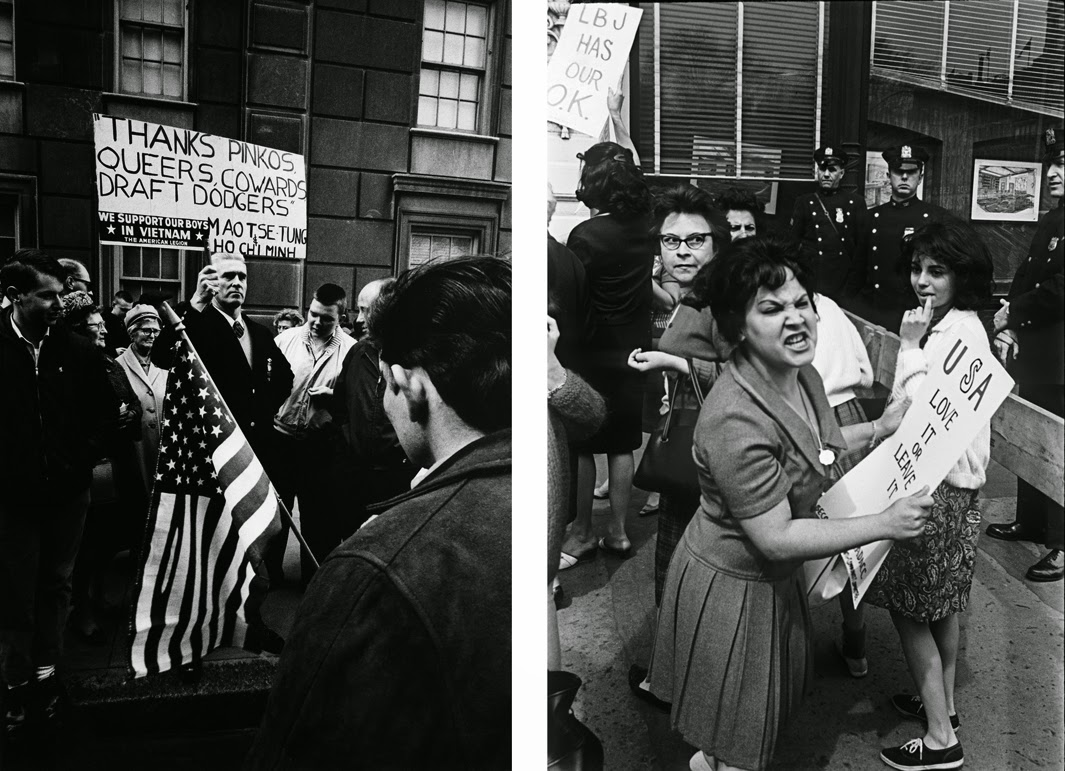
There's a great collection of 60s protest photos over at Slate, and they're definitely worth taking a few minutes to peruse. My particular favorite is a picture of some guys burning their draft cards who look more like they got lost on their way to the math club than they do crazy radicals. And that's one of the more powerful things that one is reminded of looking at the pictures -- as much as that decade and its political movements have been caricatured since then, it's important to remember these were real people, often suffering real consequences for putting their reputations, bodies, and sometimes even lives on the line to fight for political change they believed in. And as much as they've been stereotyped as long-haired white burnouts and afro'd Black revolutionaries, most of the people in these various movements were just regular ol' people, indistinguishable from you, me and all the rest of upstanding society.
But what really strikes me about these photos is how very, very little has changed amongst those who oppose political progress. Check out the sweet sign the stoic citizen in the photo on the left has there -- virtually indistinguishable from the things I've had shouted at me at various demonstrations against my generation's pointless war of imperialism. I guess the weapons, tactics, and locations of our wars of folly can change, but our catastrophic failures will always be the fault of pinkos, queers, and cowards...
Thursday, June 05, 2014
Coded Language and Sports
To regular readers of this blog, it may appear as if I'm obsessed with racially-coded language. And to a certain extent I am. I think it's because dog whistle racism is one of those things that is so painfully obvious to anyone with a slight amount of awareness, and yet so many people continue to deny it exists. So I'm always interested when something like this comes along: deadspin recently posted a measure derived from hundreds of thousands of words in pre-draft scouting reports of potential NFL prospects and sorted them by race.
The results are not the least bit surprising to anyone who follows sports. In fact, I often assign watching an afternoon of football to my classes when I'm teaching about race: spend just a half hour watching football (or any sport with a decent amount of racial diversity) and catalogue the kinds of words announcers and commentators use to describe athletes of various races. Undoubtedly white athletes will get labels implying they work hard -- they're gritty, tough, blue-collar -- or that they are highly intelligent -- they've got game smarts, they're students of the game, etc. On the flip side, athletes of color are spoken of often as inhuman workhorses -- they're strong, powerful, natural, gifted athletes. The difference is that white athletes are spoken of as having worked hard and studied to get to their skill level, while athletes of color are spoken of as being naturally athletic (the implication being they're neither smart nor hard-working).
But lest I be open to claims of reading too much into this, let's see how scouts talked about white athletes:


And how did they speak about Black athletes? Well...


I could go on posting these all day, but I think you get the point. Seriously, though, you should just go try it out yourself. It's both an enlightening and depressing experience, as are most times one learns about the world...
The results are not the least bit surprising to anyone who follows sports. In fact, I often assign watching an afternoon of football to my classes when I'm teaching about race: spend just a half hour watching football (or any sport with a decent amount of racial diversity) and catalogue the kinds of words announcers and commentators use to describe athletes of various races. Undoubtedly white athletes will get labels implying they work hard -- they're gritty, tough, blue-collar -- or that they are highly intelligent -- they've got game smarts, they're students of the game, etc. On the flip side, athletes of color are spoken of often as inhuman workhorses -- they're strong, powerful, natural, gifted athletes. The difference is that white athletes are spoken of as having worked hard and studied to get to their skill level, while athletes of color are spoken of as being naturally athletic (the implication being they're neither smart nor hard-working).
But lest I be open to claims of reading too much into this, let's see how scouts talked about white athletes:
And how did they speak about Black athletes? Well...
I could go on posting these all day, but I think you get the point. Seriously, though, you should just go try it out yourself. It's both an enlightening and depressing experience, as are most times one learns about the world...
Monday, May 26, 2014
So That Crazy Misogynist Murder Thing...
As you're already obviously aware, a highly-deluded Men's Rights Activist (redundant) killed several random women for not sleeping with him. I don't know of a better way to summarize it than with that seemingly incomprehensible sentence. I say that sentence is incomprehensible because it shouldn't be a sentence that exists and it should make no sense, but unfortunately it's exactly what happened. Even more unfortunate is the number of men who are earnestly arguing this is why women should sleep with any man who asks, walks by them, or just exists, apparently.
There's already been about a thousand different think pieces written on this, but this one is probably the best I've read. It's short and very well written, so I highly suggest you go take the three minutes necessary to read it. I'll wait. Done? Good. I really like how Dr. McDevitt highlights the impossible double standard young women (well, all women, but especially young women) in our society face: if you do have sex with men, you're a stupid whore who deserves to be bullied to death; if you don't have sex with men, you're a stupid controlling bitch who deserves to die for being withholding (if you're a woman who has sex with other women, you're allowed to film it for the pleasure of men, but you should be denied all civil rights, if I understand the argument correctly).
What I would like to selfishly add to the conversation is that this is why discourse matters, why fighting against misogyny in all its forms matters, and frankly, why sociology matters. Because analyzing the incredibly toxic form of masculinity subscribed to by these MRA types is exactly what sociology does, but it's also exactly the kind of thing that creationists* use to mock sociology as a useless discipline. "Why would you bother studying this and taking these people seriously? They're just some losers on the internet. Only people with nothing better to do with their time would think this is worth talking about." I've gotten that exact response from all sorts of people when discussing these kinds of issues, the idea that how people talk about things doesn't matter, and that if someone is espousing reprehensible garbage we can simply ignore them and they'll go away.
But such a position fails to understand how important discourse is in creating real, material social effects. For a dramatic example, see John Hagan's work on how racial discourse was used to spur the genocide in Darfur. In this case, it's extremely clear how the toxic discourse and ideology of the men's rights movement strongly contributed to, if not caused, this horrible tragedy. As much as anyone may want to blame this on mental illness (whenever white people kill someone, it's always because of mental illness), it's simple empirical fact the vast, vast majority of people with mental illness never harm anyone (in fact, they are far more likely to be harmed themselves). Even if there is some magical psychological cause is found to be behind this, the particular form such murderous rage took was unequivocally influenced by this loose collective of men who feel women are unfairly controlling them and deserve retribution for their unforgivable crime of not fucking any man who wants them.
And that's why studying (and fighting against) these horrible forms of discourse is important and necessary. Because they're not just words, they're words that clearly direct people to action. And this particular murder spree is far from an isolated case -- in fact, that very same night, three men fired eight rounds at a fleeing group of women who had refused to have sex with them. I could go ahead and link to about a thousand similar stories, but it's too depressing and you have google. But please do remember this the next time someone claims a social issue is not important and we should just all ignore it.
*I've encountered far too many people, even highly educated people, that just dismiss the entire field of sociology out of hand, with essentially no knowledge of what sociology even is. They're using the same logic of creationists -- they either don't understand or don't like what sociologists have to say (or both), so they just claim it's not real. I've taken to referring to them as creationists, because most educated people rightly take that as an insult. But science deniers are science deniers, regardless of the specific science they're denying.
There's already been about a thousand different think pieces written on this, but this one is probably the best I've read. It's short and very well written, so I highly suggest you go take the three minutes necessary to read it. I'll wait. Done? Good. I really like how Dr. McDevitt highlights the impossible double standard young women (well, all women, but especially young women) in our society face: if you do have sex with men, you're a stupid whore who deserves to be bullied to death; if you don't have sex with men, you're a stupid controlling bitch who deserves to die for being withholding (if you're a woman who has sex with other women, you're allowed to film it for the pleasure of men, but you should be denied all civil rights, if I understand the argument correctly).
What I would like to selfishly add to the conversation is that this is why discourse matters, why fighting against misogyny in all its forms matters, and frankly, why sociology matters. Because analyzing the incredibly toxic form of masculinity subscribed to by these MRA types is exactly what sociology does, but it's also exactly the kind of thing that creationists* use to mock sociology as a useless discipline. "Why would you bother studying this and taking these people seriously? They're just some losers on the internet. Only people with nothing better to do with their time would think this is worth talking about." I've gotten that exact response from all sorts of people when discussing these kinds of issues, the idea that how people talk about things doesn't matter, and that if someone is espousing reprehensible garbage we can simply ignore them and they'll go away.
But such a position fails to understand how important discourse is in creating real, material social effects. For a dramatic example, see John Hagan's work on how racial discourse was used to spur the genocide in Darfur. In this case, it's extremely clear how the toxic discourse and ideology of the men's rights movement strongly contributed to, if not caused, this horrible tragedy. As much as anyone may want to blame this on mental illness (whenever white people kill someone, it's always because of mental illness), it's simple empirical fact the vast, vast majority of people with mental illness never harm anyone (in fact, they are far more likely to be harmed themselves). Even if there is some magical psychological cause is found to be behind this, the particular form such murderous rage took was unequivocally influenced by this loose collective of men who feel women are unfairly controlling them and deserve retribution for their unforgivable crime of not fucking any man who wants them.
And that's why studying (and fighting against) these horrible forms of discourse is important and necessary. Because they're not just words, they're words that clearly direct people to action. And this particular murder spree is far from an isolated case -- in fact, that very same night, three men fired eight rounds at a fleeing group of women who had refused to have sex with them. I could go ahead and link to about a thousand similar stories, but it's too depressing and you have google. But please do remember this the next time someone claims a social issue is not important and we should just all ignore it.
*I've encountered far too many people, even highly educated people, that just dismiss the entire field of sociology out of hand, with essentially no knowledge of what sociology even is. They're using the same logic of creationists -- they either don't understand or don't like what sociologists have to say (or both), so they just claim it's not real. I've taken to referring to them as creationists, because most educated people rightly take that as an insult. But science deniers are science deniers, regardless of the specific science they're denying.
Thursday, May 22, 2014
What If We Treated All Education Like We Treat College?
By far one of the most annoying and disturbing trends in discussions around higher education is the pressure to conform a liberal arts education to the trade school model. That is, according to many, we should quit teaching all of this namby pamby "theory" and "art" and "literature" and anything else that isn't immediately and directly transferrable to one's future employment (leaving aside, of course, the fact that many things which don't seem immediately applicable to the job market, like say a better understanding of how various cultures interact, actually can significantly aid one in finding employment. Or the fact that we can't chemical engineer or business administration away institutional racism and structural inequality, but anyway).
I was especially reminded of this when mindlessly scrolling through this typically obnoxious buzzfeed post of commencement speech quotes that someone posted on facebook. The most striking was a quote from Ed Helms, saying "if you majored in Classics, that one's on you. We'll be seeing you and your bust of Euripides at job fairs for years to come." Even going beyond how dripping with unearned condescension that quote is, the fact that it's coming from an actor is especially rich. Especially one with a degree in film theory. You know, the exact kind of major someone at his own commencement probably made fun of for being useless and never leading to employment. Except of course it's led him to roughly $20 million net worth, indicating maybe it was a fairly worthwhile major after all, if you're measuring in terms of future earnings.
But my point is not about whether more esoteric majors can lead to good future earnings, and in fact, I think that is a profoundly misguided way to look at college majors. Because not everything learned in college needs to be exclusively and directly applicable to some sort of job. Beyond the obvious fact that the job market keeps evolving and there's a decent chance today's graduate may end up in a few years applying for a job that doesn't exist right now, a liberal arts education is not meant to be a vocational school. It's meant to teach you applicable skills, sure, but it's also meant to teach you how to be a well-rounded person with knowledge about the world.
I write this as someone who majored in Sociology and Humanities with minors in Music, History, and Philosophy. Every last one of them a "worthless" major according to the college-as-trade-school crowd. Yet here I am, gainfully employed in my chosen field. But the bigger point is that I didn't take those classes to get a job, I took those classes to learn things. Sure, my philosophy courses provided me with few skills applicable to the various jobs I've had, but they challenged my worldview and understanding of life in profound ways. Ways that made me a significantly better person for having pondered and worked through.
So I often wonder what elementary education would look like if we applied this same mentality. Learning to tie your shoes? No one's going to pay you for that. Learning right from left? No one's going to pay you for that. Learning addition and subtraction? No one's going to pay you for that. In fact, there's no job that's going to pay you for what you learn in grade school, so we should probably get rid of the whole thing, right?
I was especially reminded of this when mindlessly scrolling through this typically obnoxious buzzfeed post of commencement speech quotes that someone posted on facebook. The most striking was a quote from Ed Helms, saying "if you majored in Classics, that one's on you. We'll be seeing you and your bust of Euripides at job fairs for years to come." Even going beyond how dripping with unearned condescension that quote is, the fact that it's coming from an actor is especially rich. Especially one with a degree in film theory. You know, the exact kind of major someone at his own commencement probably made fun of for being useless and never leading to employment. Except of course it's led him to roughly $20 million net worth, indicating maybe it was a fairly worthwhile major after all, if you're measuring in terms of future earnings.
But my point is not about whether more esoteric majors can lead to good future earnings, and in fact, I think that is a profoundly misguided way to look at college majors. Because not everything learned in college needs to be exclusively and directly applicable to some sort of job. Beyond the obvious fact that the job market keeps evolving and there's a decent chance today's graduate may end up in a few years applying for a job that doesn't exist right now, a liberal arts education is not meant to be a vocational school. It's meant to teach you applicable skills, sure, but it's also meant to teach you how to be a well-rounded person with knowledge about the world.
I write this as someone who majored in Sociology and Humanities with minors in Music, History, and Philosophy. Every last one of them a "worthless" major according to the college-as-trade-school crowd. Yet here I am, gainfully employed in my chosen field. But the bigger point is that I didn't take those classes to get a job, I took those classes to learn things. Sure, my philosophy courses provided me with few skills applicable to the various jobs I've had, but they challenged my worldview and understanding of life in profound ways. Ways that made me a significantly better person for having pondered and worked through.
So I often wonder what elementary education would look like if we applied this same mentality. Learning to tie your shoes? No one's going to pay you for that. Learning right from left? No one's going to pay you for that. Learning addition and subtraction? No one's going to pay you for that. In fact, there's no job that's going to pay you for what you learn in grade school, so we should probably get rid of the whole thing, right?
Friday, May 09, 2014
Obamacare and Fun With Latin Logic Phrases
One of my favorite time wasting activities is looking up Latin phrases for logical fallacies (I clearly have a very active social life). It's not just that whipping out a Latin phrase at the right time makes you look super smart and/or pretentious, but that often they have a beautiful simplicity that captures a rather lengthy argument in just a few words.
But since I never studied Latin, I often find myself looking for a specific phrase but having to reverse engineer it through the magic of google (so I often find myself searching something to the effect of "Latin phrase meaning your conclusion does not follow your premises," or some such). Today's Latin logic phrase of the day is Ignoratio Elenchi, meaning when one presents an argument that is solidly logical, but does nothing to support the conclusion they're advocating.
I thought of this while reading yet another complain about the Affordable Care Act this morning and wondering why I find myself so often in disagreement with conservative critics of the ACA when I myself hate the ACA. I think it's because while there are many, many valid criticisms of the act, so many of the most vocal critics of it use what are basically non sequiturs in their attacks, clearly starting from the position that Anything Obama Does = Bad, and then working backwards from there to figure out why any particular action itself is bad.
For instance, one of the most common criticisms of the ACA I see from very vocal opponents is the idea that it will not be financially solvent unless enough healthy young people who rarely use their benefits sign up for it to defray the costs of taking care of older and/or sicker people who use many more resources.
The problem with this line of reasoning is that the idea that a health insurance program will only work with enough healthy people to offset the people actually using their benefits is not a criticism of the ACA, it's a criticism of the concept of health insurance itself. This is the exact logic the entire private insurance system is based on, a logic that was in place long before Mitt Romney and co. developed the plan that would eventually become the ACA. Now, if you were proposing an alternative in which our health care is socialized and the government uses the awesome purchasing power of 300+ million people to negotiate affordable rates on medical care, then you could criticize this model. But if your alternative is to return to the system that invented this model in the first place, the critique rings pretty hollow.
Which is what I think makes it such a good example of in ignoratio elenchi. Because the idea that young, healthy people who use very few medical resources are necessary to offset the costs of people who actually use medical resources is a valid critique of a system of medicine. But when your counterproposal to what exists is based on the exact same logic, well…again, that's just not a very good criticism. Instead, it's clearly a criticism that began with the assumption the ACA is terrible and then worked backward to find specific faults. Of which there are many, but this one doesn't work.
But since I never studied Latin, I often find myself looking for a specific phrase but having to reverse engineer it through the magic of google (so I often find myself searching something to the effect of "Latin phrase meaning your conclusion does not follow your premises," or some such). Today's Latin logic phrase of the day is Ignoratio Elenchi, meaning when one presents an argument that is solidly logical, but does nothing to support the conclusion they're advocating.
I thought of this while reading yet another complain about the Affordable Care Act this morning and wondering why I find myself so often in disagreement with conservative critics of the ACA when I myself hate the ACA. I think it's because while there are many, many valid criticisms of the act, so many of the most vocal critics of it use what are basically non sequiturs in their attacks, clearly starting from the position that Anything Obama Does = Bad, and then working backwards from there to figure out why any particular action itself is bad.
For instance, one of the most common criticisms of the ACA I see from very vocal opponents is the idea that it will not be financially solvent unless enough healthy young people who rarely use their benefits sign up for it to defray the costs of taking care of older and/or sicker people who use many more resources.
The problem with this line of reasoning is that the idea that a health insurance program will only work with enough healthy people to offset the people actually using their benefits is not a criticism of the ACA, it's a criticism of the concept of health insurance itself. This is the exact logic the entire private insurance system is based on, a logic that was in place long before Mitt Romney and co. developed the plan that would eventually become the ACA. Now, if you were proposing an alternative in which our health care is socialized and the government uses the awesome purchasing power of 300+ million people to negotiate affordable rates on medical care, then you could criticize this model. But if your alternative is to return to the system that invented this model in the first place, the critique rings pretty hollow.
Which is what I think makes it such a good example of in ignoratio elenchi. Because the idea that young, healthy people who use very few medical resources are necessary to offset the costs of people who actually use medical resources is a valid critique of a system of medicine. But when your counterproposal to what exists is based on the exact same logic, well…again, that's just not a very good criticism. Instead, it's clearly a criticism that began with the assumption the ACA is terrible and then worked backward to find specific faults. Of which there are many, but this one doesn't work.
Thursday, May 08, 2014
Donald Sterling, "The Free Market" as Coded Language, and a McDonald's That Sells Spaghetti and Blankets
I've been following the whole Donald Sterling fiasco pretty closely and one of the most interesting arguments I've come across in the many pieces I've read about it is from a faction of people who believe the NBA should not have done anything and should have instead let the "free market" sort it out. Of course here I'm using the term "interesting" in the passive-aggressive Midwestern sense, in that anything that doesn't make sense gets politely termed interesting. Because this argument most definitely does not make sense.
What is this free market argument? As always, it involves the free market magically doing the right thing, but more specifically, these folks are arguing that the NBA was wrong to intervene, because had they just left everything alone, fans would have decided not to patronize the Clippers, players would have decided not to play for the Clippers, advertisers and other corporate sponsors would have cut ties with the Clippers, and on and on until the market forced Sterling out.
While this line of thinking obviously ignores quite a bit of what we know about reality (ranging from the fact that many fans have continued to support their teams through far worse controversies, players are under contract and can't just up and leave the franchise without huge difficulties, advertisers have shown their complete willingness to work with utterly despicable people, etc.), it's interesting in how it not only shows how humorous free market fetishism is, but how it's becoming a loaded code word on the level of "states rights."
Much as proponents of states rights will say that slavery or segregation were really bad and they truly, honestly disagree with the practice but just think the federal government doesn't have the right to intervene in such situations, the "free market will fix it crowd" similarly pretends to be upset with Sterling, but just doesn't like the heavy-handed actions of the NBA.
But I say "pretends to" because that's obviously not the case. Because the NBA has neither acted with a heavy hand according to their own corporate franchising model, but even more so because this is actually a pretty prime example of the market forcing this change (without any government intervention whatsoever).
Why isn't it heavy handed for the NBA to force a sale of the Clippers (which has not happened yet but appears quite likely at this time)? Because the Clippers are not an independent business, but a franchise of the NBA. This is why the NBA can have things like salary caps or the ability to trade their employees, because technically the teams are all just subsets of one corporate entity (the NBA). These things would be gross violations of labor and business law if all 30 teams were actually completely separate businesses. So it's more akin to how individual McDonalds are independently owned and operated, but at the discretion of the McDonalds corporation and the ability to run one can be revoked at any time.
Which brings mean to the McDs that only sells spaghetti and blankets, as imagined by the late, great Mitch Hedberg (the joke starts at about 44 seconds in):
For those to lazy to watch or for when the video is inevitably taken down, the crux of the joke is that Mitch notes the end of McDonalds commercials always end with "prices and participation may vary," so he jokes about opening a McDonalds that doesn't participate in anything. It's a good joke. But of course in reality if any McDonalds owner were to do anything even close to that their franchise would be yanked away immediately. Which is more-or-less what the NBA is doing toStern Sterling (whoops! confused my S-named morons associated with the NBA).
But what really exposes the "Oh, I totally oppose whatStern Sterling has said and done, I just believe in the purity of the free market" argument to be a lie is that the free market is exactly why Stern Sterling is losing the team. The NBA, a private corporation, seeing the mountains of bad press, the threats of fans and advertisers to quit supporting the league until something was done, and a potential strike of both the Clippers and their first-round playoff opponent Warriors, decided that to protect their revenue streams, they needed to discontinue their relationship with Donald Sterling. This was all done without even the threat of government interference. A purely business decision made by a private business. The ouster of Donald Sterling couldn't get more free market if Ayn Rand came back from the dead to team up with Ron Paul to personally arrange a hostile takeover of the Clippers.
And this is why the free market argument is clearly a code word meant to derail the conversation from one about the continuing presence of racism in our society to one of how private businesses should be allowed to act. Because again, this was pretty much the model example of the free market taking care of things with no outside intervention. So if you're going to use the notion that it should have been left up to the free market when that is unequivocally what has already happened, it makes it pretty clear that maybe your problem is more that this was one of those rare occasions in which someone's life-long legacy of overt and institutional racism finally brought some consequences...
What is this free market argument? As always, it involves the free market magically doing the right thing, but more specifically, these folks are arguing that the NBA was wrong to intervene, because had they just left everything alone, fans would have decided not to patronize the Clippers, players would have decided not to play for the Clippers, advertisers and other corporate sponsors would have cut ties with the Clippers, and on and on until the market forced Sterling out.
While this line of thinking obviously ignores quite a bit of what we know about reality (ranging from the fact that many fans have continued to support their teams through far worse controversies, players are under contract and can't just up and leave the franchise without huge difficulties, advertisers have shown their complete willingness to work with utterly despicable people, etc.), it's interesting in how it not only shows how humorous free market fetishism is, but how it's becoming a loaded code word on the level of "states rights."
Much as proponents of states rights will say that slavery or segregation were really bad and they truly, honestly disagree with the practice but just think the federal government doesn't have the right to intervene in such situations, the "free market will fix it crowd" similarly pretends to be upset with Sterling, but just doesn't like the heavy-handed actions of the NBA.
But I say "pretends to" because that's obviously not the case. Because the NBA has neither acted with a heavy hand according to their own corporate franchising model, but even more so because this is actually a pretty prime example of the market forcing this change (without any government intervention whatsoever).
Why isn't it heavy handed for the NBA to force a sale of the Clippers (which has not happened yet but appears quite likely at this time)? Because the Clippers are not an independent business, but a franchise of the NBA. This is why the NBA can have things like salary caps or the ability to trade their employees, because technically the teams are all just subsets of one corporate entity (the NBA). These things would be gross violations of labor and business law if all 30 teams were actually completely separate businesses. So it's more akin to how individual McDonalds are independently owned and operated, but at the discretion of the McDonalds corporation and the ability to run one can be revoked at any time.
Which brings mean to the McDs that only sells spaghetti and blankets, as imagined by the late, great Mitch Hedberg (the joke starts at about 44 seconds in):
For those to lazy to watch or for when the video is inevitably taken down, the crux of the joke is that Mitch notes the end of McDonalds commercials always end with "prices and participation may vary," so he jokes about opening a McDonalds that doesn't participate in anything. It's a good joke. But of course in reality if any McDonalds owner were to do anything even close to that their franchise would be yanked away immediately. Which is more-or-less what the NBA is doing to
But what really exposes the "Oh, I totally oppose what
And this is why the free market argument is clearly a code word meant to derail the conversation from one about the continuing presence of racism in our society to one of how private businesses should be allowed to act. Because again, this was pretty much the model example of the free market taking care of things with no outside intervention. So if you're going to use the notion that it should have been left up to the free market when that is unequivocally what has already happened, it makes it pretty clear that maybe your problem is more that this was one of those rare occasions in which someone's life-long legacy of overt and institutional racism finally brought some consequences...
Tuesday, May 06, 2014
Privileged White Guy Does Not Believe In White Privilege
A you've probably heard or read by now, a Princeton freshman wrote an article for an astroturf conservative collegiate newspaper about how he's never experienced white privilege (despite, you know, being a freshman in college whose poorly written essay has now been featured in Time magazine, among many other outlets). I'm not going to link to it directly because the last thing dude needs is more page views, but here's a great take down of how moronic it is.
The reason the piece has blown up is pretty obvious, as it taps into a ton of white resentment over the fact that it's no longer particularly acceptable to publicly proclaim people of color stupid/unworthy and how that's apparently super unfair to white people.
I'm not here to explain what white privilege is or to prove it exists (I've written about it tons and tons and tons and tons before, and at this point in the development of the term and empirical findings in the field, if you're denying it exists you're basically the social science version of a creationist).
What's most annoying about this kid's tone deaf essay is the deliberate misunderstanding of the term. Literally no one is asking him (or any other white person) to apologize for being white or for getting where they are. The entire point of asking people to check their privilege is to simply remind them that the world is not particularly fair, and to remember that the unfairness of the world tends to work in their advantage. No one's saying you haven't overcome difficulties in your life, just that other people also have difficulties, and probably more than you do if you're a straight white guy at Princeton. Which, to borrow a popular analogy, is pretty much the lowest difficulty setting possible.
But this kid wrestling with the concept of privilege actually reminded me of a bizarro version of myself at his age. As a college activist only beginning to learn of the many horrors of our world I, like many others, began to feel like I was not allowed to be sad or upset about anything. Sure, that girl dumped me and broke my heart, but do you have any idea what's going on in Darfur right now?!?
It's a long process for many activists to realize that just because other people have it objectively worse than you doesn't mean you're not allowed to feel shitty when shitty things happen to you. A much healthier way to approach it is just to remember some perspective when you're feeling shitty. So I hit on a new way to think of the concept of checking one's privilege.
When I was a senior in college, I broke my ankle in a pick up basketball game. Not in the figurative sense that someone juked me out of my sneakers, but in the literal sense that I displaced a number of the "floating" bones in my ankle. And that really, really hurt. Like, "scream a string of obscenities every time I even tried to move my ankle for months" kind of pain. It took months of physical therapy to regain the use of that ankle, and to this day I only have about 75% motion in it.
Contrast this with a friend of a friend who a few years ago died from a very aggressive cancer. In fact, by the end, it had so thoroughly spread throughout his skeleton that his bones were literally snapping due to the pressure of the enormous cancerous growths inside of them. His last weeks were spent writhing in unimaginable pain.
No obviously that guy's situation was simply objectively worse than mine, no matter how you slice it. Although breaking my ankle like that was by far the most physical pain I've ever experienced, it's not even a sliver of what that guy went through. To compare them on any level is frankly insulting to his memory.
But that doesn't mean breaking my ankle didn't hurt really, really bad. You see, both things are possible: just because he went through something exponentially worse does not mean my situation didn't suck pretty bad. For me to compare the two would be absurd, and people would be right to be upset with me were I so stupid as to do so.
And that's all we're asking when we ask you to check your privilege: we're not saying you don't have any difficulties in your life, or that you have to apologize for anything. We're simply pointing out that your broken ankle is not nearly as difficult to overcome as that guy's super-aggressive cancer, and that you probably shouldn't complain to the dude with cancer about how your ankle hurts. That's all.
The reason the piece has blown up is pretty obvious, as it taps into a ton of white resentment over the fact that it's no longer particularly acceptable to publicly proclaim people of color stupid/unworthy and how that's apparently super unfair to white people.
I'm not here to explain what white privilege is or to prove it exists (I've written about it tons and tons and tons and tons before, and at this point in the development of the term and empirical findings in the field, if you're denying it exists you're basically the social science version of a creationist).
What's most annoying about this kid's tone deaf essay is the deliberate misunderstanding of the term. Literally no one is asking him (or any other white person) to apologize for being white or for getting where they are. The entire point of asking people to check their privilege is to simply remind them that the world is not particularly fair, and to remember that the unfairness of the world tends to work in their advantage. No one's saying you haven't overcome difficulties in your life, just that other people also have difficulties, and probably more than you do if you're a straight white guy at Princeton. Which, to borrow a popular analogy, is pretty much the lowest difficulty setting possible.
But this kid wrestling with the concept of privilege actually reminded me of a bizarro version of myself at his age. As a college activist only beginning to learn of the many horrors of our world I, like many others, began to feel like I was not allowed to be sad or upset about anything. Sure, that girl dumped me and broke my heart, but do you have any idea what's going on in Darfur right now?!?
It's a long process for many activists to realize that just because other people have it objectively worse than you doesn't mean you're not allowed to feel shitty when shitty things happen to you. A much healthier way to approach it is just to remember some perspective when you're feeling shitty. So I hit on a new way to think of the concept of checking one's privilege.
When I was a senior in college, I broke my ankle in a pick up basketball game. Not in the figurative sense that someone juked me out of my sneakers, but in the literal sense that I displaced a number of the "floating" bones in my ankle. And that really, really hurt. Like, "scream a string of obscenities every time I even tried to move my ankle for months" kind of pain. It took months of physical therapy to regain the use of that ankle, and to this day I only have about 75% motion in it.
Contrast this with a friend of a friend who a few years ago died from a very aggressive cancer. In fact, by the end, it had so thoroughly spread throughout his skeleton that his bones were literally snapping due to the pressure of the enormous cancerous growths inside of them. His last weeks were spent writhing in unimaginable pain.
No obviously that guy's situation was simply objectively worse than mine, no matter how you slice it. Although breaking my ankle like that was by far the most physical pain I've ever experienced, it's not even a sliver of what that guy went through. To compare them on any level is frankly insulting to his memory.
But that doesn't mean breaking my ankle didn't hurt really, really bad. You see, both things are possible: just because he went through something exponentially worse does not mean my situation didn't suck pretty bad. For me to compare the two would be absurd, and people would be right to be upset with me were I so stupid as to do so.
And that's all we're asking when we ask you to check your privilege: we're not saying you don't have any difficulties in your life, or that you have to apologize for anything. We're simply pointing out that your broken ankle is not nearly as difficult to overcome as that guy's super-aggressive cancer, and that you probably shouldn't complain to the dude with cancer about how your ankle hurts. That's all.
Thursday, May 01, 2014
A Long Semester is Finally Over
Been updating far less than usual lately due to the time crunch of the end of the semester. This is not only a busy time for all the obvious reasons (grading, mainly) but also because this is the time of the semester when students suddenly develop debilitating problems that only effect them retroactively, which is why they don't deserve the D they earned but instead should really get at least a B. I mean, come on, if I don't get at least a B my GPA won't be high enough to get into the business major and this is somehow your problem even though you don't know me. It's a fascinating mindset.
So I've been digging out from under a deluge of panicked student e-mails. Sometimes they're at least legitimately hilarious, but it always makes me feel like if these folks put half the effort into class that they put into coming up with elaborate excuses as to why they did terribly in the class, they wouldn't have to make up said excuses in the first place. But then I guess they'd be forced to learn something, and that is most definitely not why one goes to college.
I thought I could head off a lot of this by announcing in class (multiple times!) that I would not entertain any e-mails asking for a change in grade (if something that monumental actually happened to you, it shouldn't take you 3 months to inform your professors of it) nor would I answer any e-mails asking when they'll get their final grades. Because the final grades come out in a pretty timely manner, and it shockingly turns out that knowing your grade two days earlier doesn't at all effect what the grade is.
While for privacy reasons I can't actually copy any of those e-mails here, I will say they take on a bizarro, almost gonzo spirit of making no sense. So far the winner is an e-mail I got literally less than an hour after a class meeting in which I repeatedly announced that any e-mails from students asking to get their final grade early would be immediately deleted with no response. Sure enough, by the time I grabbed some lunch after class and got back to my office, there was already an e-mail from a student asking if I could please send them their final grade. Leaving aside the notion that I am apparently able to grade 60 term papers and finals in less than an hour, I'd like to think this person was intentionally trying to be funny, but I fear that's giving them way, way too much credit.
What makes this even more aggravating/darkly hilarious is that in addition to my repeated announcements (and the inclusion of this on the syllabus), all students in our department are required to take an introduction to the major that doubles as college skills orientation in which I know for a fact the professor who teaches it covers exactly this kind of thing (e.g. what it is and is not appropriate to e-mail your professor over). So the students have gotten this message multiple times before they get to the point of annoying me, and yet either assume that such rules of decorum do not apply to them or (more likely) weren't paying attention the multiple times when they were given this information.
And that's the most dispiriting thing of all -- if they're not even able to listen closely enough to grasp what is already common sense even after hearing it multiple times, it doesn't give me a ton of faith that they're grasping any of the actual course content. Which is something I (and most other professors) already knew, it's just unpleasant to receive constant reminders of this fact.
But hey, I'm done with students for the summer. Here's hoping next fall brings a batch of folks who are interested in their education, or failing that, at least are able to listen to simple instructions...
So I've been digging out from under a deluge of panicked student e-mails. Sometimes they're at least legitimately hilarious, but it always makes me feel like if these folks put half the effort into class that they put into coming up with elaborate excuses as to why they did terribly in the class, they wouldn't have to make up said excuses in the first place. But then I guess they'd be forced to learn something, and that is most definitely not why one goes to college.
I thought I could head off a lot of this by announcing in class (multiple times!) that I would not entertain any e-mails asking for a change in grade (if something that monumental actually happened to you, it shouldn't take you 3 months to inform your professors of it) nor would I answer any e-mails asking when they'll get their final grades. Because the final grades come out in a pretty timely manner, and it shockingly turns out that knowing your grade two days earlier doesn't at all effect what the grade is.
While for privacy reasons I can't actually copy any of those e-mails here, I will say they take on a bizarro, almost gonzo spirit of making no sense. So far the winner is an e-mail I got literally less than an hour after a class meeting in which I repeatedly announced that any e-mails from students asking to get their final grade early would be immediately deleted with no response. Sure enough, by the time I grabbed some lunch after class and got back to my office, there was already an e-mail from a student asking if I could please send them their final grade. Leaving aside the notion that I am apparently able to grade 60 term papers and finals in less than an hour, I'd like to think this person was intentionally trying to be funny, but I fear that's giving them way, way too much credit.
What makes this even more aggravating/darkly hilarious is that in addition to my repeated announcements (and the inclusion of this on the syllabus), all students in our department are required to take an introduction to the major that doubles as college skills orientation in which I know for a fact the professor who teaches it covers exactly this kind of thing (e.g. what it is and is not appropriate to e-mail your professor over). So the students have gotten this message multiple times before they get to the point of annoying me, and yet either assume that such rules of decorum do not apply to them or (more likely) weren't paying attention the multiple times when they were given this information.
And that's the most dispiriting thing of all -- if they're not even able to listen closely enough to grasp what is already common sense even after hearing it multiple times, it doesn't give me a ton of faith that they're grasping any of the actual course content. Which is something I (and most other professors) already knew, it's just unpleasant to receive constant reminders of this fact.
But hey, I'm done with students for the summer. Here's hoping next fall brings a batch of folks who are interested in their education, or failing that, at least are able to listen to simple instructions...
Wednesday, April 23, 2014
People Tell Me I Don't Look Good With Long Hair
So the other day I was googling my own name. For a specific reason, not just for the novelty of it (specifically, I was working on google-bombing my department website profile to be the first response to my name. It was for work!). But although I had an actual purpose in doing this, it's hard not to get sucked down the rabbit hole of what little bits of ephemera about me have ended up on the ol' interwebs (not to mention the fun of seeing who else has my less-than-conventional name out there in the world).
Clicking around, I eventually ended up on the image results for my name. Why I chose to click on a particular picture of me I have no recollection, but the one I did click on took me to this…uh…unique blog discussing some sort of metaphysical connection between hermaphrodites and…noses? I guess? It's pretty confusing and I didn't really bother reading most of it.
The whole thing is, again, quite odd, but the funniest part is when the author gets to a discussion of President Clinton, and specifically his daughter Chelsea. At that point, the author of this particular post feels it necessary to include a picture of Chelsea, so there's this photo and caption:

Clicking around, I eventually ended up on the image results for my name. Why I chose to click on a particular picture of me I have no recollection, but the one I did click on took me to this…uh…unique blog discussing some sort of metaphysical connection between hermaphrodites and…noses? I guess? It's pretty confusing and I didn't really bother reading most of it.
The whole thing is, again, quite odd, but the funniest part is when the author gets to a discussion of President Clinton, and specifically his daughter Chelsea. At that point, the author of this particular post feels it necessary to include a picture of Chelsea, so there's this photo and caption:
Eagle-eyed readers will note that does not appear to be Chelsea Clinton. Readers who know me personally will note that is actually me. I mean, sure, my hair was pretty long when this picture was taken, but do I really look that much like the daughter of our 42nd president? Now that I look at it, I guess maybe? Maybe a little bit?
Like so many things on the internet, this just raises so many questions for me. The biggest of which is: I don't really look that much like Chelsea Clinton do I? I mean, other than the hair, I feel like we don't look that much alike.
No, actually the biggest question is how whomever wrote that blog got this picture. I've tried to reverse engineer the process by doing an image search for the young Clinton, and as far as I can see, no picture of me ever comes up. So whomever found this had to have been looking through some other source, and then found this picture of me and figured I look close enough to work. But that just raises so many more questions: where and how did they find this particular picture? And then how did they make the leap to thinking it was Chelsea Clinton despite it presumably not being identified as a picture of her, and also presumably being in a context that has nothing to do with the Clintons?
And seriously, I don't look like Chelsea Clinton, do I?
Friday, April 18, 2014
Racial Disparities Are Not Racial Profiling
Teaching criminology courses, and especially police courses, the topic of "racial profiling" comes up a lot. It often surprises my students to hear me, Johnny Long Hair Hippie Professor, say that racial profiling basically doesn't exist. Sure, there are unfortunately plenty of examples of law enforcement who clearly set out to harass people of color. But fortunately, those folks are very much in the minority (pun most definitely not intended).
The real problem is that police are human beings. And like all human beings, they are subject to the social forces that all people are. So in trying to understand why there are huge racial disparities in our criminal justice system (despite there not being huge disparities in who is committing crimes) does not come from a bunch of racist police, prosecutors, judges, etc. setting about to harass and imprison people of color. Rather, it comes from the fact that we live in a racist society, and becoming a criminal justice official doesn't magically make on immune to social forces.
Take this recent study that gave law firm partners identical copies of a memo that contained 22 objective errors in spelling, grammar, and fact. The only difference in the study was that some of the partners were told the memo was written by a white person and some were told the memo was written by a Black person.
Well, as anyone even remotely familiar with American society could have guessed, those who thought they were reviewing the writing of a Black person were far more likely to find more mistakes than those who thought they were reviewing the writing of a white person. On a subjective scale of how well the partners thought the memo was written, the "Black" memo received an average rating (on a 5-point scale) of 3.2 while the "white" memo averaged 4.1 But more telling, amongst the objective errors (misspelled words and claims that were factually wrong), the reviewers found on average 2.9 mistakes in the "white" memos and 5.8 mistakes in the "Black" memos.
Again, these memos were the exact same thing. The only variable changed was whether the reviewer thought the memo was written by a white or Black person. Then even in things that are objectively either right or wrong, like spelling, the reviewers were much more likely to notice the mistakes in the "Black" memo. This is in line with many previous audit-style studies that have found things such as with identical resumes submitted for a job application, those with white-sounding names are significantly more likely to receive a call back/job offer than those with black-sounding names.
The point of such studies is to demonstrate that even in completely objective areas, the (perceived) race of the person being evaluated still makes a significant difference. These studies do a good job destroying the "well, if Black people didn't want [x bad thing happening], they shouldn't do [y thing]." But as the writing sample studies shows, Black people would have to be roughly twice as good with spelling as their white counterparts just to be viewed as equal.
So what does this have to do with racial profiling? Because we're all criminals. This is a point I make to my students constantly -- there are so many laws on the books at just the federal level alone that no one actually knows how many laws exist. The most conservative estimates put it at roughly 10,000 laws at the federal level alone. If you actually dig into all the laws on the books, you'll find that you're breaking multiple laws per day without probably even knowing it. For example, in nearly every state it is illegal to have anything hanging from the rear-view mirror of your car, or to have any stickers on any window of your car that were not issues by the state. And yet I know dozens of people who do exactly that.
This becomes a problem for equal enforcement -- if basically everyone is breaking the law at all times, how do you chose who to stop and who to let go? After all, police can neither practically nor politically detain every citizen every time they break the law, or we would all be in jail right now.
So instead, like all human beings, police use context clues to help them distinguish between who to investigate and who to ignore. When you combine that with a society that has an incredibly strong connection between dark skin and the suspicion of criminality, it's not surprising that so many officers would, again not intentionally, end up making people of color their main focus. And since we're all pretty much constantly breaking the law, they will more often than not find people of color doing something illegal, thus justifying their suspicions. Of course, were they to pay the same amount of attention to white citizens they would find the same amount of crime, but that counter-factual rarely enters into most people's thinking.
I really like studies like the writing study up top, because they demonstrate so forcefully how even in rather inconsequential areas of life race is an incredibly strong factor in how people are perceived. Of course in writing samples it may not be the biggest deal in the world, but when such disparities in perception move into the realm of criminal justice, hopefully I don't have to explain why they become much more significant. But more than anything else, they completely destroy the regressive, simplistic, and ultimately racist argument of "Well, if Black people don't want to be arrested so much, they should quite committing so much crime." Because as these studies (and dozens others like them) prove, the real formula there would be "Well, if Black people don't want to be arrested so much, they should quit being Black in public."
The real problem is that police are human beings. And like all human beings, they are subject to the social forces that all people are. So in trying to understand why there are huge racial disparities in our criminal justice system (despite there not being huge disparities in who is committing crimes) does not come from a bunch of racist police, prosecutors, judges, etc. setting about to harass and imprison people of color. Rather, it comes from the fact that we live in a racist society, and becoming a criminal justice official doesn't magically make on immune to social forces.
Take this recent study that gave law firm partners identical copies of a memo that contained 22 objective errors in spelling, grammar, and fact. The only difference in the study was that some of the partners were told the memo was written by a white person and some were told the memo was written by a Black person.
Well, as anyone even remotely familiar with American society could have guessed, those who thought they were reviewing the writing of a Black person were far more likely to find more mistakes than those who thought they were reviewing the writing of a white person. On a subjective scale of how well the partners thought the memo was written, the "Black" memo received an average rating (on a 5-point scale) of 3.2 while the "white" memo averaged 4.1 But more telling, amongst the objective errors (misspelled words and claims that were factually wrong), the reviewers found on average 2.9 mistakes in the "white" memos and 5.8 mistakes in the "Black" memos.
Again, these memos were the exact same thing. The only variable changed was whether the reviewer thought the memo was written by a white or Black person. Then even in things that are objectively either right or wrong, like spelling, the reviewers were much more likely to notice the mistakes in the "Black" memo. This is in line with many previous audit-style studies that have found things such as with identical resumes submitted for a job application, those with white-sounding names are significantly more likely to receive a call back/job offer than those with black-sounding names.
The point of such studies is to demonstrate that even in completely objective areas, the (perceived) race of the person being evaluated still makes a significant difference. These studies do a good job destroying the "well, if Black people didn't want [x bad thing happening], they shouldn't do [y thing]." But as the writing sample studies shows, Black people would have to be roughly twice as good with spelling as their white counterparts just to be viewed as equal.
So what does this have to do with racial profiling? Because we're all criminals. This is a point I make to my students constantly -- there are so many laws on the books at just the federal level alone that no one actually knows how many laws exist. The most conservative estimates put it at roughly 10,000 laws at the federal level alone. If you actually dig into all the laws on the books, you'll find that you're breaking multiple laws per day without probably even knowing it. For example, in nearly every state it is illegal to have anything hanging from the rear-view mirror of your car, or to have any stickers on any window of your car that were not issues by the state. And yet I know dozens of people who do exactly that.
This becomes a problem for equal enforcement -- if basically everyone is breaking the law at all times, how do you chose who to stop and who to let go? After all, police can neither practically nor politically detain every citizen every time they break the law, or we would all be in jail right now.
So instead, like all human beings, police use context clues to help them distinguish between who to investigate and who to ignore. When you combine that with a society that has an incredibly strong connection between dark skin and the suspicion of criminality, it's not surprising that so many officers would, again not intentionally, end up making people of color their main focus. And since we're all pretty much constantly breaking the law, they will more often than not find people of color doing something illegal, thus justifying their suspicions. Of course, were they to pay the same amount of attention to white citizens they would find the same amount of crime, but that counter-factual rarely enters into most people's thinking.
I really like studies like the writing study up top, because they demonstrate so forcefully how even in rather inconsequential areas of life race is an incredibly strong factor in how people are perceived. Of course in writing samples it may not be the biggest deal in the world, but when such disparities in perception move into the realm of criminal justice, hopefully I don't have to explain why they become much more significant. But more than anything else, they completely destroy the regressive, simplistic, and ultimately racist argument of "Well, if Black people don't want to be arrested so much, they should quite committing so much crime." Because as these studies (and dozens others like them) prove, the real formula there would be "Well, if Black people don't want to be arrested so much, they should quit being Black in public."
Wednesday, April 09, 2014
Crime, Memory, and Rape Culture
At last summer's meetings of the American Sociological Association I ended up at a talk discussing a methodological development for getting accurate data regarding people's movements (how or why I was there I don't recall, and I'm too lazy to dig up last year's program and remember who was doing the presenting). The relevant point is that this group of researchers, who if I remember correctly were interested in the daily routines and activities of young people, were trying to get around a classic problem of social research: people don't necessarily have particularly good recall about what has happened to them. It's simply a function of how memory works; there are scores of psychological and sociological studies on how the brain operates, how memory operates, how our brain often fills in missing details with what we think should have happened, etc.
So to get around this problem, they issued every participant in their study a GPS-enabled smart phone that they were to keep on themselves at all times. To show how much more effective and accurate this method was compared to self-reporting, the presenter showed several examples of the GPS-generated maps of people's movements against their self-reported activities.
It turns out the two were often quite different. I remember one example in particular in which someone's self report simply read that they came home from school, then a couple of hours later went to the museum with a friend, and then went home again. But the GPS map showed they ad actually stopped at a corner store on the way home, rode their bike around aimlessly for awhile, went to their friends house before going to the museum, and a few other little trips around the neighborhood.
The point of these examples were to demonstrate how faulty human memory is about most things we do and experience, even events that happened the previous day (think about it yourself: try to list everything you did yesterday. I'm pretty confident you'll find there are rather sizable chunks of time you can't fully account for). And it wasn't like these study participants were intentionally lying; not only was there no discernible motivation for lying about, say, riding your bike around, but when presented with the discrepancies, most participants immediately remembered the events they had forgotten and even apologized to the researchers for their forgetting.
It's important to remember these omissions happened during normal days in which nothing extraordinary happened to these folks. So what does this have to do with crime and rape culture? Well, I was reading a piece the other day on the on-going, mistake-filled investigation of sexual assault charges against Florida State quarterback Jameis Winston. For those of you not familiar, it appears by all accounts to be a classic case of multiple levels of university and public officials looking the other way when a famous athlete has been charged with rape (as the article linked to points out, at this point the only options are that the University and local PD had either intentionally covered this up/dragged their feet on the investigation OR they are so incompetent as to force the question of why any of them are still employed).
But Winston's defenders, who are quick to flood the comments section of any article on the subject, continually point to the fact that the victim's story has changed some from when it was first reported to the police. Granted, these people are pretty clearly folks who already don't believe Winston's accuser and are working backwards to find socially acceptable reasons as to why (most such comments I've read go on to accuse the woman of being a gold-digger, which is not only patently offensive on it's own, but makes zero sense. In all my years studying the criminal justice system, I've never once heard of someone being ordered to pay financial restitution to a person they are convicted of sexually assaulting).
But as the research above (and a giant line of research before it) makes painfully clear is that human memory doesn't work like that. After all, if people have difficulty remembering what happened to them on a normal day, it's not too big of a stretch to say people who have just experienced a traumatic event in which they were possibly drugged would have an even harder time.
But a rational human being who doesn't start from the position that all women are jezebel whores who deserve whatever happens to them doesn't even need the piles and piles of empirical evidence proving human memory does not work like that. Because again, you can try it yourself: the next time you have a night out at the bar, wake yourself up at 4 a.m. and then immediately state every detail of the previous night. Unless you have a photographic memory, I guarantee you will not be able to account for every minute of the evening. And then I further guarantee that if you were to come back to that account a few days later, you will probably have had time to remember some other things that happened, or forget details of things you previously remembered. Now imagine reporting that story to an officer that openly lets you know they don't believe you and being fully aware that any small mistake you make will result in thousands of shit heads calling you a gold-digging whore online and in real life...
So to get around this problem, they issued every participant in their study a GPS-enabled smart phone that they were to keep on themselves at all times. To show how much more effective and accurate this method was compared to self-reporting, the presenter showed several examples of the GPS-generated maps of people's movements against their self-reported activities.
It turns out the two were often quite different. I remember one example in particular in which someone's self report simply read that they came home from school, then a couple of hours later went to the museum with a friend, and then went home again. But the GPS map showed they ad actually stopped at a corner store on the way home, rode their bike around aimlessly for awhile, went to their friends house before going to the museum, and a few other little trips around the neighborhood.
The point of these examples were to demonstrate how faulty human memory is about most things we do and experience, even events that happened the previous day (think about it yourself: try to list everything you did yesterday. I'm pretty confident you'll find there are rather sizable chunks of time you can't fully account for). And it wasn't like these study participants were intentionally lying; not only was there no discernible motivation for lying about, say, riding your bike around, but when presented with the discrepancies, most participants immediately remembered the events they had forgotten and even apologized to the researchers for their forgetting.
It's important to remember these omissions happened during normal days in which nothing extraordinary happened to these folks. So what does this have to do with crime and rape culture? Well, I was reading a piece the other day on the on-going, mistake-filled investigation of sexual assault charges against Florida State quarterback Jameis Winston. For those of you not familiar, it appears by all accounts to be a classic case of multiple levels of university and public officials looking the other way when a famous athlete has been charged with rape (as the article linked to points out, at this point the only options are that the University and local PD had either intentionally covered this up/dragged their feet on the investigation OR they are so incompetent as to force the question of why any of them are still employed).
But Winston's defenders, who are quick to flood the comments section of any article on the subject, continually point to the fact that the victim's story has changed some from when it was first reported to the police. Granted, these people are pretty clearly folks who already don't believe Winston's accuser and are working backwards to find socially acceptable reasons as to why (most such comments I've read go on to accuse the woman of being a gold-digger, which is not only patently offensive on it's own, but makes zero sense. In all my years studying the criminal justice system, I've never once heard of someone being ordered to pay financial restitution to a person they are convicted of sexually assaulting).
But as the research above (and a giant line of research before it) makes painfully clear is that human memory doesn't work like that. After all, if people have difficulty remembering what happened to them on a normal day, it's not too big of a stretch to say people who have just experienced a traumatic event in which they were possibly drugged would have an even harder time.
But a rational human being who doesn't start from the position that all women are jezebel whores who deserve whatever happens to them doesn't even need the piles and piles of empirical evidence proving human memory does not work like that. Because again, you can try it yourself: the next time you have a night out at the bar, wake yourself up at 4 a.m. and then immediately state every detail of the previous night. Unless you have a photographic memory, I guarantee you will not be able to account for every minute of the evening. And then I further guarantee that if you were to come back to that account a few days later, you will probably have had time to remember some other things that happened, or forget details of things you previously remembered. Now imagine reporting that story to an officer that openly lets you know they don't believe you and being fully aware that any small mistake you make will result in thousands of shit heads calling you a gold-digging whore online and in real life...
Monday, March 31, 2014
#CancelColbert, Offense, and Proper Reactions
Late last week, Stephen Colbert had a bit mocking Daniel Snyder, owner of the Washington professional football team (you know, the one with a racial slur for a team name). As you may have heard, Snyder has established the Original Americans Foundation, one of the most blatant PR moves in history, in which he's supplied some coats and the portion of the cost of one backhoe, to a few tribal groups in order to try to paper over the fact his team is named a racial slur (note: the charity is not named the Redskins Foundation, almost as if Snyder understands it's not a word one should be using).
In his patented way, Colbert mocked this by doing his own faux-racist schtick, claiming to start the Ching Chong Ding Dong Foundation for Sensitivity to Orientals or Whatever (go watch the clip for why this makes sense in context -- in fact, the context is extremely, extremely important).
The bit was classic Colbert -- taking a ridiculous position and pushing it only slightly further to demonstrate how incredibly stupid that position is. Having watched the clip as it first aired, it could not have been more obvious the butt of the joke was Snyder and his hypocritical cashing in on a racist slur while trying to buy his way out of it. It was similarly obvious that Asian people were not being made fun of, but merely serving as a contrast to show how we wouldn't accept Snyder's racist shenanigans with any other ethnic group (why we accept it against natives is an entirely different post).
The problem came when the show's official twitter feed (not run by Colbert or anyone working on the show) tweeted out the name of the satirical foundation completely out of context. And out of context, it does seem pretty damn offensive. This led noted twitter activist Suey Park to call for the cancellation of the Colbert Report and made the hashtag #cancelcolbert trend.
And that, as this excellent commentary notes, is when the shit hit the fan. Especially as a number of people who had no idea of the context of the joke hopped on the bandwagon.
And here's where things get thorny for me. I'm very much of the school that holds it's condescending and basically an asshole move to tell someone they have no right to be offended by something (especially when you add the layer of race in, as a white dude I have no place telling a person of color something isn't racist and they should't be offended by it). This is both because a) emotions themselves are never "wrong," it's how you react to them, but more importantly 2) the thornier issues of status and privilege and all that.
Though while I'm never comfortable telling someone they should not be offended, I also have a problem with the blanket assumption that one's offense trumps all else (again, I'm typically on board with that position, just not as an absolute). Because this situation reminds me a great deal of a time I was googling around to see if there were any fun, short readings from popular media about the police subculture for a class I was teaching. There ended up being a link for a policeone message board, which are always humorous, so I decided to check it out (policeone is a news and quasi-social media site for law enforcement).
Anyway, someone had posted a message asking if anyone on there had good info on the police subculture for a continuing ed course they were taking. Another poster took extreme offense to this, writing something to the effect of "How dare you say the police are a subculture? We're not sub anything! Why don't you take your hatred of law enforcement elsewhere!"
So obviously that person was offended, but this starts to veer into the territory where they were empirically wrong to be offended. Because for the two of you out there who don't know the term, "subculture" is not a term that implies any judgement (positive or negative). It simply refers to a smaller culture that exists within a larger culture. Not only does the "sub" mean "smaller than" not "lesser than," but it's also a pretty widespread term that any American adult should have heard of and know. So while we may not be able to say that person was wrong to be offended, it's also pretty clear that person was in the wrong -- not only was no offensive thing actually written, but even a cursory google search for the meaning of the term would have let that person know what they were interpreting as offensive was actually a completely value-free term applied to widely disparate groups.
Where it gets tricky is that exact last point -- what responsibility does the offended party have? To bring it back to the Colbert example (which is admittedly much thornier than someone not knowing what the word subculture means), Park mentioned in her initial tweet that she was a fan of Colbert. Which means she has to be aware that his whole schtick is playing a clueless right-wing extremist in the mold of the Limbaughs and O'Reillys of the world. So seeing that (admittedly much more offensive out of context) tweet, she could have easily surmised that rather than Colbert suddenly turning unapologetically racist, maybe there was some context to what was going on (as if the "or whatever" at the end of it didn't indicate this was satire). And if you actually do watch the clip in context, it was so clear the butt of the joke is Snyder and the racism of the team name that they may as well have been running a disclaimer at the bottom of the screen reading "WARNING: this is satire. Obviously no one here believes these derogatory stereotypes of Asians. They are being deployed to illustrate how unacceptable racism against Natives is." But obviously Park (nor the many others making the hashtag trend) bothered to check in on that context. Context which completely changes the joke.
But this just brings us back to the beginning and how hard these things are to weigh -- is it me being a clueless white guy saying "no, person of color, you don't get to be offended by what the white guy said," or is it an example of someone almost willfully ignoring the context of what was said, taking offense at something clearly not doing what they claim it to be (that is, mocking Asian people)? Or can it be both?
To quote the authors of the commentary linked to above (who, like Park, both happen to be Americans of Korean descent), Park's reading of this "flattens out all meaning and pretends, in effect, that there is no ironic distance between Jonathan Swift's satire and actual cannibalism." I like that comparison quite a bit -- obviously Swift was not at all advocating the eating of Irish babies. But not being Irish myself, were I to happen upon an Irish person who found Swift incredibly offensive for suggesting such a ghastly act, would/could/should I point out it really seems they're really misinterpreting the story?
In his patented way, Colbert mocked this by doing his own faux-racist schtick, claiming to start the Ching Chong Ding Dong Foundation for Sensitivity to Orientals or Whatever (go watch the clip for why this makes sense in context -- in fact, the context is extremely, extremely important).
The bit was classic Colbert -- taking a ridiculous position and pushing it only slightly further to demonstrate how incredibly stupid that position is. Having watched the clip as it first aired, it could not have been more obvious the butt of the joke was Snyder and his hypocritical cashing in on a racist slur while trying to buy his way out of it. It was similarly obvious that Asian people were not being made fun of, but merely serving as a contrast to show how we wouldn't accept Snyder's racist shenanigans with any other ethnic group (why we accept it against natives is an entirely different post).
The problem came when the show's official twitter feed (not run by Colbert or anyone working on the show) tweeted out the name of the satirical foundation completely out of context. And out of context, it does seem pretty damn offensive. This led noted twitter activist Suey Park to call for the cancellation of the Colbert Report and made the hashtag #cancelcolbert trend.
And that, as this excellent commentary notes, is when the shit hit the fan. Especially as a number of people who had no idea of the context of the joke hopped on the bandwagon.
And here's where things get thorny for me. I'm very much of the school that holds it's condescending and basically an asshole move to tell someone they have no right to be offended by something (especially when you add the layer of race in, as a white dude I have no place telling a person of color something isn't racist and they should't be offended by it). This is both because a) emotions themselves are never "wrong," it's how you react to them, but more importantly 2) the thornier issues of status and privilege and all that.
Though while I'm never comfortable telling someone they should not be offended, I also have a problem with the blanket assumption that one's offense trumps all else (again, I'm typically on board with that position, just not as an absolute). Because this situation reminds me a great deal of a time I was googling around to see if there were any fun, short readings from popular media about the police subculture for a class I was teaching. There ended up being a link for a policeone message board, which are always humorous, so I decided to check it out (policeone is a news and quasi-social media site for law enforcement).
Anyway, someone had posted a message asking if anyone on there had good info on the police subculture for a continuing ed course they were taking. Another poster took extreme offense to this, writing something to the effect of "How dare you say the police are a subculture? We're not sub anything! Why don't you take your hatred of law enforcement elsewhere!"
So obviously that person was offended, but this starts to veer into the territory where they were empirically wrong to be offended. Because for the two of you out there who don't know the term, "subculture" is not a term that implies any judgement (positive or negative). It simply refers to a smaller culture that exists within a larger culture. Not only does the "sub" mean "smaller than" not "lesser than," but it's also a pretty widespread term that any American adult should have heard of and know. So while we may not be able to say that person was wrong to be offended, it's also pretty clear that person was in the wrong -- not only was no offensive thing actually written, but even a cursory google search for the meaning of the term would have let that person know what they were interpreting as offensive was actually a completely value-free term applied to widely disparate groups.
Where it gets tricky is that exact last point -- what responsibility does the offended party have? To bring it back to the Colbert example (which is admittedly much thornier than someone not knowing what the word subculture means), Park mentioned in her initial tweet that she was a fan of Colbert. Which means she has to be aware that his whole schtick is playing a clueless right-wing extremist in the mold of the Limbaughs and O'Reillys of the world. So seeing that (admittedly much more offensive out of context) tweet, she could have easily surmised that rather than Colbert suddenly turning unapologetically racist, maybe there was some context to what was going on (as if the "or whatever" at the end of it didn't indicate this was satire). And if you actually do watch the clip in context, it was so clear the butt of the joke is Snyder and the racism of the team name that they may as well have been running a disclaimer at the bottom of the screen reading "WARNING: this is satire. Obviously no one here believes these derogatory stereotypes of Asians. They are being deployed to illustrate how unacceptable racism against Natives is." But obviously Park (nor the many others making the hashtag trend) bothered to check in on that context. Context which completely changes the joke.
But this just brings us back to the beginning and how hard these things are to weigh -- is it me being a clueless white guy saying "no, person of color, you don't get to be offended by what the white guy said," or is it an example of someone almost willfully ignoring the context of what was said, taking offense at something clearly not doing what they claim it to be (that is, mocking Asian people)? Or can it be both?
To quote the authors of the commentary linked to above (who, like Park, both happen to be Americans of Korean descent), Park's reading of this "flattens out all meaning and pretends, in effect, that there is no ironic distance between Jonathan Swift's satire and actual cannibalism." I like that comparison quite a bit -- obviously Swift was not at all advocating the eating of Irish babies. But not being Irish myself, were I to happen upon an Irish person who found Swift incredibly offensive for suggesting such a ghastly act, would/could/should I point out it really seems they're really misinterpreting the story?
Thursday, March 27, 2014
Because You Need This
From our friends at Slate, here is every hairstyle Prince has had from 1978 to 2013.
This, my friends, is why the internet exists.

This, my friends, is why the internet exists.
Tuesday, March 25, 2014
Dog Whistle Racism Explained By An Insider
On the heels of writing about racial coding and dog whistle racism in America, I happened to read this article about Paul Ryan trying to backtrack from his assertion that all poverty stems from Black people being lazy (or something like that, it's kind of hard to follow his logic).
But more to the point, the piece uses a fantastic quote I'd been trying to dig up for a while from Alexander P. Lamis' book "The Two-Party South." At the time the book was published (1984) the quote was simply from an anonymous source identified as a Reagan confident, but is now known to be famed conservative operative Lee Atwater. It's especially important because often people who discuss racial coding are accused of reading too much into the words used, or projecting their own ideas on to the speaker.
But this quote from Atwater is not someone interpreting his words, or projecting words on to him, it's just him straight-up explaining exactly how Republicans have intentionally used racially coded language to make racist appeals to their white, Souther voting base while maintaining the plausible deniability of supposedly not talking about race.
But enough with the set up, here's Atwater in his own words:
So no, when Ryan and his ilk talk of "inner city laziness" and the need to stop "fostering dependance on government assistance," social scientists are not "reading too much into it" when we note that these are obviously racist statements designed to rile up racist white voters. All we're doing is saying in public what Atwater was more than comfortable admitting behind closed doors...
But more to the point, the piece uses a fantastic quote I'd been trying to dig up for a while from Alexander P. Lamis' book "The Two-Party South." At the time the book was published (1984) the quote was simply from an anonymous source identified as a Reagan confident, but is now known to be famed conservative operative Lee Atwater. It's especially important because often people who discuss racial coding are accused of reading too much into the words used, or projecting their own ideas on to the speaker.
But this quote from Atwater is not someone interpreting his words, or projecting words on to him, it's just him straight-up explaining exactly how Republicans have intentionally used racially coded language to make racist appeals to their white, Souther voting base while maintaining the plausible deniability of supposedly not talking about race.
But enough with the set up, here's Atwater in his own words:
"You start out in 1954 by saying, ‘N—-r, n—-r, n—-r.’ By 1968 you can’t say ‘n—-r’ — that hurts you. Backfires. So you say stuff like forced busing, states’ rights and all that stuff. You’re getting so abstract now [that] you’re talking about cutting taxes, and all these things you’re talking about are totally economic things and a byproduct of them is [that] blacks get hurt worse than whites. And subconsciously maybe that is part of it. I’m not saying that. But I’m saying that if it is getting that abstract, and that coded, that we are doing away with the racial problem one way or the other. You follow me — because obviously sitting around saying, ‘We want to cut this,’ is much more abstract than even the busing thing, and a hell of a lot more abstract than ‘N—-r, n—-r.'"
So no, when Ryan and his ilk talk of "inner city laziness" and the need to stop "fostering dependance on government assistance," social scientists are not "reading too much into it" when we note that these are obviously racist statements designed to rile up racist white voters. All we're doing is saying in public what Atwater was more than comfortable admitting behind closed doors...
Wednesday, March 19, 2014
I Do Not Think That Word Means What You Think It Means
I often joke that you can tell when a conservative is discussing the Middle East, because they suddenly turn into radical feminists. Sure, they hate abortion, pass restrictive legislation limiting access to birth control, underfund women's health initiatives, mock rape victims, and generally believe women to be sub-human baby incubators. But when discussion turns to anywhere the people are brown, all of a sudden we Have to Save the Women™!
Of course, they don't care about Middle Eastern women (or men or children), but it's become unacceptable to publicly say they're a worthless people and we can kill them and take over their nations anytime we like. So instead, suddenly these folks are really concerned about women's rights (but only over there).
A corollary to that joke is that anytime a conservative invokes Freedom of Speech™, it is a very safe bet some prominent conservative has just been fired for saying something incredibly racist, sexist, homophobic, etc.
Which brings me to this picture currently floating around the interwebs:

It's a picture of a bunch of supposed historical re-enactors, dressed up like Nazis, having a dinner party in a private room of Minneapolis restaurant Gasthof zur Gemutlichkeit, complete with Nazi banners and other regalia strewn about (on MLK day, for an added bonus).
I'm not even going to touch how idiotic that is, as any functioning human adult can immediately understand why this is a terrible idea. Rather, I want to focus on the comments of the owner of the restaurant (which have been echoed by several of the Nazis in the photo) aimed at the people criticizing him for hosting the event:
"We live in a free country...but from the comments I see, a lot of people they don’t see what freedom is."
Except…no. The constitutionally guaranteed right to free speech specifically prevents the government (or more specifically, anyone acting on behalf of the government) to censor one's speech or activities without compelling reason. Since not a single one of the people in this photo, in the group, or employed by the restaurant has been subject to any government action as a result of this, it means their freedoms are perfectly intact.
So repeat it with me kids: freedom of speech does not mean freedom from consequences.
So while no one has the right to prevent you from being the kind of fucking moron who thinks dressing up and playing Nazi is a fun thing to do, everyone has the complete right to tell you you're a fucking jackass for doing so. That's not them imposing limits on your freedom of speech, that's them exercising their freedom of speech.
A violation of your free speech would be if the police had prevented the dinner in the first place, or arrested them all afterward. And if that happened, as much as I loathe these people, I'd be first in line to defend them. But that didn't happen; they are all currently walking about freely with no chance of criminal conviction stemming from this. That is why I'm also happy to be right in line to tell them they are horrible people who need to seriously re-evaluate their life choices.
But whether it be dressing up like Nazis, or telling a national publication that Black people were happier under segregation and gay people are an abomination, conservatives seem to believe that any criticism of their words or actions is automatically illegal censorship (quite ironic given their love for censorship in every other arena, but that's another topic for another day). Apparently, to them, freedom of speech means everyone not only has to let you speak, they have to listen to you speak, and have to then agree with whatever you said.
But that's not how it works. You've got your freedom of speech to dress up like the people who slaughtered at least 6 million human beings and have a grand ol' time being a giant asshole. But everyone else has the freedom to tell you you're a giant asshole.
I'll let the last word go to Dr. Degrasse Tyson. While it's on a different subject, the general principle remains the same:

Of course, they don't care about Middle Eastern women (or men or children), but it's become unacceptable to publicly say they're a worthless people and we can kill them and take over their nations anytime we like. So instead, suddenly these folks are really concerned about women's rights (but only over there).
A corollary to that joke is that anytime a conservative invokes Freedom of Speech™, it is a very safe bet some prominent conservative has just been fired for saying something incredibly racist, sexist, homophobic, etc.
Which brings me to this picture currently floating around the interwebs:
It's a picture of a bunch of supposed historical re-enactors, dressed up like Nazis, having a dinner party in a private room of Minneapolis restaurant Gasthof zur Gemutlichkeit, complete with Nazi banners and other regalia strewn about (on MLK day, for an added bonus).
I'm not even going to touch how idiotic that is, as any functioning human adult can immediately understand why this is a terrible idea. Rather, I want to focus on the comments of the owner of the restaurant (which have been echoed by several of the Nazis in the photo) aimed at the people criticizing him for hosting the event:
"We live in a free country...but from the comments I see, a lot of people they don’t see what freedom is."
Except…no. The constitutionally guaranteed right to free speech specifically prevents the government (or more specifically, anyone acting on behalf of the government) to censor one's speech or activities without compelling reason. Since not a single one of the people in this photo, in the group, or employed by the restaurant has been subject to any government action as a result of this, it means their freedoms are perfectly intact.
So repeat it with me kids: freedom of speech does not mean freedom from consequences.
So while no one has the right to prevent you from being the kind of fucking moron who thinks dressing up and playing Nazi is a fun thing to do, everyone has the complete right to tell you you're a fucking jackass for doing so. That's not them imposing limits on your freedom of speech, that's them exercising their freedom of speech.
A violation of your free speech would be if the police had prevented the dinner in the first place, or arrested them all afterward. And if that happened, as much as I loathe these people, I'd be first in line to defend them. But that didn't happen; they are all currently walking about freely with no chance of criminal conviction stemming from this. That is why I'm also happy to be right in line to tell them they are horrible people who need to seriously re-evaluate their life choices.
But whether it be dressing up like Nazis, or telling a national publication that Black people were happier under segregation and gay people are an abomination, conservatives seem to believe that any criticism of their words or actions is automatically illegal censorship (quite ironic given their love for censorship in every other arena, but that's another topic for another day). Apparently, to them, freedom of speech means everyone not only has to let you speak, they have to listen to you speak, and have to then agree with whatever you said.
But that's not how it works. You've got your freedom of speech to dress up like the people who slaughtered at least 6 million human beings and have a grand ol' time being a giant asshole. But everyone else has the freedom to tell you you're a giant asshole.
I'll let the last word go to Dr. Degrasse Tyson. While it's on a different subject, the general principle remains the same:
Subscribe to:
Comments (Atom)